To truly understand the scale of FC Groningen’s influence, one only needs to analyze the addresses of the advertisers tucked onto the back pages of the matchday programme. The club does not just belong to the city; it is the undisputed sporting capital of the entire Northern province. A collage of advertisements featuring a paint shop from Winschoten (Winschoten Verf & Wand), an installation firm from Siddeburen (ReWo Montage), and a notary office from the border town of Ter Apel (Notariaat Ter Apel) paints a vivid picture of this regional dominance.
These towns and villages make up the “Ommeland”—the vast, rural hinterland surrounding the city. For a business in the far-eastern outpost of Ter Apel, right on the German border, investing in a sponsor block at the Euroborg is a statement of regional loyalty. It proves that no matter how far away from the stadium they are located, local entrepreneurs consider it a point of pride to financially back the Pride of the North.
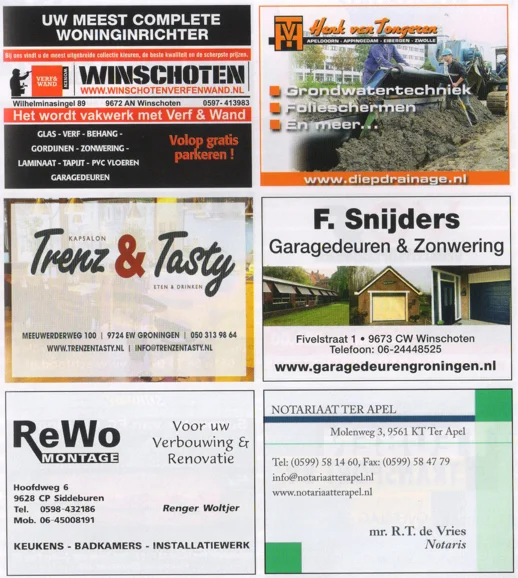
This geographical spread is the economic engine of the club. FC Groningen survives and thrives not on a single billionaire owner, but on the collective, unwavering support of hundreds of small and medium enterprises scattered across towns like Winschoten and Siddeburen. Every paint job sold and every legal document notarized in the province indirectly contributes to the success of the green-and-white on the pitch.
A Look into the Future
By 2026, the demographic and economic landscape of the Ommeland has shifted, with significant investments aimed at revitalizing border towns and rural communities. Businesses in Winschoten and Ter Apel have adapted to a more digital economy, but their commitment to regional identity is unwavering. The club’s sponsorship network remains a vital B2B platform, where a rural mounting firm can network with international maritime companies. The bond between the city stadium and the provincial villages is tighter than ever, united by a shared Northern resilience.