ARCHIVAL EDITION
SNAPSHOT OF THE ERA

Washing Away the Paint: The Endless Battle for Clean Facades

There is a subtle, almost poetic irony hidden in the advertising columns of football programmes. Football culture, especially the hardcore ultra scene, is heavily associated with urban graffiti, stickers, and street art. Yet, on page 32 of the 2013 programme, we find an advertisement for Koos Huizing gevelonderhoud, a company specializing in exactly the opposite: “Graffity-verwijdering” (Graffiti removal) and facade cleaning.

Based in Uithuizermeeden, a village in the far north of the province, this company represents the constant, quiet maintenance required to keep Dutch cities looking pristine. Advertising graffiti removal in a football stadium is a brilliant piece of targeted B2B marketing. The stadium is filled with real estate owners, municipal contractors, and local business managers who constantly battle urban decay on their commercial properties. Koos Huizing offered a comprehensive solution: joint renovation, impregnation, and high-pressure cleaning, ensuring that the physical face of the local economy remained spotless.
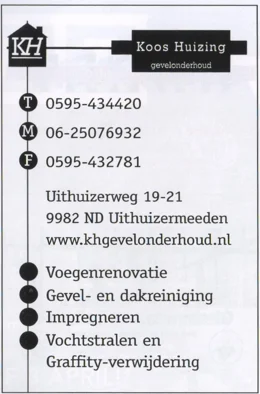
Koos Huizing facade maintenance and graffiti removal advertisement scan from FC Groningen programme 2013

A Look into the Future

In 2026, the battle between street artists and facade cleaners continues unabated, but the technology has changed. Modern graffiti removal relies heavily on eco-friendly, biodegradable solvents and laser cleaning technology, moving away from the harsh chemicals of the past. Furthermore, many municipalities, including Groningen, have adopted a more nuanced approach, designating legal street art zones to reduce illegal tagging. Yet, for commercial real estate, the services of rural maintenance companies like the one from Uithuizermeeden remain an absolute necessity in the ongoing cycle of urban renewal.

📖
This article is based on materials from the original matchday programme issued for 08.03.2013 | Groningen — NAC Breda (NL Eredivisie 2012/13).

📜 Connected Stories & Context

The Colors of Noordlaren: Remembering a Lost Local Craftsman

A digital football museum is not just a repository of sporting statistics; it is…

The Green Province: Sponsors from Winschoten to Ter Apel

To truly understand the scale of FC Groningen's influence, one only needs to analyze…

A Bite in Exloo: The Regional Reach of Eet-Café De Smidse

When mapping the true fanbase of FC Groningen, you cannot stop at the city borders….

Across the Wadden Sea: The Ameland Connection

If you want to map the true territorial footprint of a football club, look…

Books and Boots: The Dual Reality of the Academy

The layout of a matchday programme is often dictated by available space, but sometimes,…

From the Wadden Coast to the Euroborg: The Plasterers of the Deep North

The advertising pages of a football programme are a geographical map of a club's…

Hooks, Lines, and Hat-Tricks: The Deep Bond Between Football and Fishing

If you track the advertising history of FC Groningen matchday programmes across different seasons,…

Keeping the North Cold: The Invisible Industrial Backbone

Sometimes, the most critical infrastructure in a region is the one you never think…

Ladders and Scaffolding: The Unsung Heroes of the Local Economy

Tucked away in the middle of the advertising grid on page 31 are two…

Pitch Perfect: The Landscapers Cultivating the Groningen Suburbs

If there is one thing the Dutch take as seriously as their football, it…