
If there is one thing the Dutch take as seriously as their football, it is their gardens. The Netherlands has a deep, culturally ingrained obsession with landscaping, spatial design, and manicured greenery. Therefore, it makes perfect thematic sense to find an advertisement for Bartelds Hoveniersbedrijf (a landscaping company) nestled in the pages of the FC Groningen matchday programme.
Located in Onnen—a small, affluent, and highly green village just south of the city, near Haren—Bartelds offered the holy trinity of Dutch gardening: “Ontwerp, Aanleg, Onderhoud” (Design, Construction, Maintenance). The advertisement is clean and modern, featuring a stylized green tree logo and a badge noting they are “Exclusief Geselecteerd” (Exclusively Selected). The target audience here is clear: the business seat holders and wealthy sponsors sitting in the Euroborg lounges, who want their suburban backyards to look as pristine and perfectly cut as the stadium’s pitch.
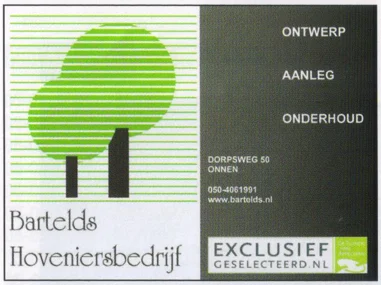
Advertising a landscaping business at a football match is a subtle psychological play. Fans spend 90 minutes staring at a perfectly maintained rectangle of grass; it is only natural that a local gardener would use that environment to sell their services.
A Look into the Future
Looking at this ad from 2026, the landscaping industry has undergone a massive ecological shift. The pristine, heavily paved, and tightly manicured gardens popular in the early 2010s have given way to the “climate-adaptive” garden movement. Today, landscapers in the Groningen region are heavily focused on biodiversity, rainwater retention, and replacing concrete tiles with native plants to combat urban heat. Companies like Bartelds have had to evolve from traditional gardeners into ecological designers, reflecting the broader environmental awakening of the region over the last decade.