
When reading historical matchday programmes, the most fascinating details are often buried in passing remarks. On page 6 of the January 2015 issue, FC Utrecht manager Robby Alflen previews the upcoming fixture against FC Groningen. He speaks of a team trying to find stability, aiming for a top-12 finish, and dealing with the absence of their injured top scorer, Ruud Boymans. But hidden in the text is a sentence that alters European football history.
Alflen casually mentions the winter transfer movements: “Sean Klaiber is loaned to Dordrecht, and Sébastien Haller is a new attacker, who made his debut last weekend.” At that moment, Haller was just a 20-year-old loanee from Auxerre, brought in to plug a gap in the Utrecht attack. Alflen’s main focus in the interview was actually on the creative output of Tommy Oar (who had provided seven assists) and the physical battle he expected at the Euroborg.
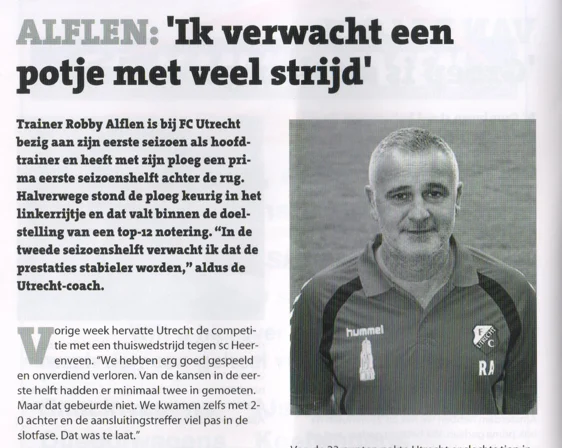
Alflen anticipated a “match with a lot of battle” (een potje met veel strijd). He recalled the reverse fixture at the Stadion Galgenwaard, where Utrecht secured a narrow 1-0 victory, aided by a missed penalty from Groningen. The Utrecht manager knew that surviving the hostile atmosphere in the North required grit, especially with a reshuffled squad relying on an unproven French youngster up front.
A Look into the Future
That “new attacker” mentioned so casually by Alflen would go on to become one of the most recognizable strikers in Europe. Sébastien Haller didn’t just plug a gap; he exploded in the Eredivisie, eventually earning massive transfers to Eintracht Frankfurt, West Ham United, Ajax, and Borussia Dortmund. By 2026, Haller’s legacy is defined not only by his incredible Champions League goalscoring records but by his inspiring, victorious battle against testicular cancer. Looking back at this 2015 programme, we are witnessing the exact moment a global footballing giant took his very first steps on Dutch soil.