Football clubs are built on history, and matchday programmes are the ledgers where this history is meticulously recorded. Page 10 of the August 2013 edition offers a deep dive into the “Head-to-Head” statistics between FC Groningen and FC Utrecht on northern soil. The headline proudly declares: “Groningen won zeven duels in Euroborg” (Groningen won seven duels in Euroborg), setting a tone of historical dominance.
The numbers presented in the “Afgelopen twintig ontmoetingen in Groningen” (Last twenty meetings in Groningen) table tell a story of a true home fortress. Out of 38 previous official meetings at home, FC Groningen had emerged victorious 19 times. What is particularly fascinating is the transition of this dominance from the gritty, intimate atmosphere of the old Oosterpark stadium to the modern concrete cathedral of the Euroborg. The text notes that since moving to the new stadium, Groningen had won 7 out of 12 encounters against Utrecht, proving that the intimidating home advantage had successfully migrated across the city.
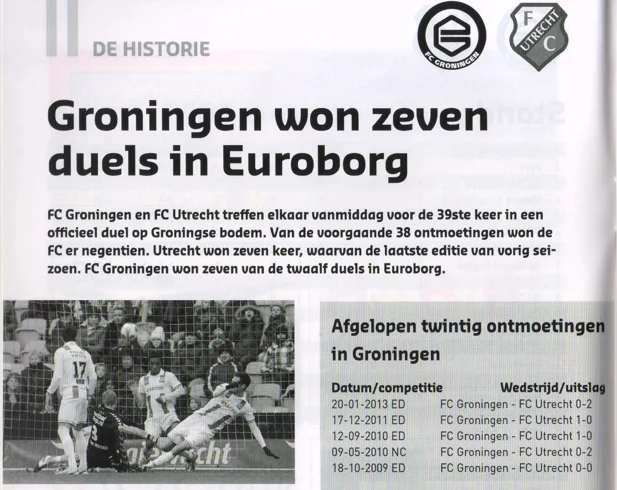
Fans reading this page before kickoff could reminisce over specific dates listed in the table, such as the crushing 4-0 victory in the playoffs on May 21, 2009, or the tense 1-0 wins in 2010 and 2012. On the opposite page, amidst traditional local services like Notariaat Ter Apel and Bouwbedrijf R. van Tongeren, sits an advertisement for the global sandwich chain Subway. However, it is distinctly localized, proudly declaring itself a “Supporter van FC Groningen” and listing its specific city addresses (Brugstraat, Sontplein, Zernike). It’s a perfect example of how even massive international franchises had to bow to the local football culture to win over the northern consumer.
A Look into the Future
The Euroborg would indeed remain a notoriously difficult place for FC Utrecht to visit. Over the next decade, matches between these two sub-top Eredivisie rivals would frequently turn into fierce, physical battles, often deciding crucial European playoff spots. The historical ledger printed on this 2013 page would continue to grow, with the “Green Cathedral” maintaining its reputation as a fortress where the passionate home crowd could tangibly influence the outcome of the game, preserving the spirit of the old Oosterpark well into the 2020s.