
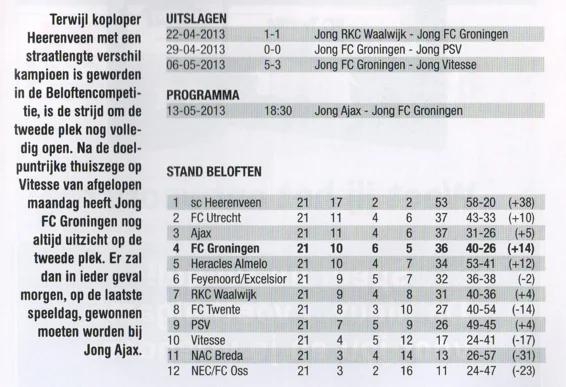
For football historians tracking the evolution of youth development, page 51 of the May 2013 programme is a fascinating artifact. Dedicated to Jong FC Groningen (the club’s reserve team), the page details their campaign in the “Beloftencompetitie”—a league structure that no longer exists in this format.
The text reveals a tense end-of-season scenario. While northern rivals SC Heerenveen had already secured the championship by a “street length,” Jong FC Groningen was locked in a fierce battle for second place. Following a thrilling 5-3 victory over Jong Vitesse, the team was preparing for a decisive final match against Jong Ajax. The league table printed on the page shows a closed ecosystem of reserve teams, including FC Utrecht, Heracles Almelo, and PSV. In 2013, this was how Dutch clubs bridged the gap between the academy and the first team: playing Monday night matches in mostly empty stadiums against other reserves.
A Look into the Future
Looking at this page from the perspective of 2026 highlights one of the most controversial and impactful structural changes in Dutch football history. Shortly after this 2012/2013 season, the KNVB (Dutch FA) radically restructured the pyramid. They abolished the traditional Beloftencompetitie and integrated the strongest reserve teams (like Jong Ajax and Jong PSV) directly into the professional Eerste Divisie (Keuken Kampioen Divisie) to play against senior professional men. FC Groningen took a different strategic path over the following decade, eventually pulling their reserve team out of the standard senior pyramid to focus on the specialized Under-21 league. The table printed in this 2013 programme is a relic of a discarded era, capturing the final days of the old Dutch reserve system.