
Before a football club undergoes a massive structural overhaul, it is always worth looking at the baseline of talent they were already producing. In the “Nieuws” column of the September 2014 matchday programme, FC Groningen proudly announced a wave of international call-ups for their youth academy players, providing a snapshot of a highly promising generation.
Under the header “HANDVOL INTERNATIONALS IN ORANJE-SELECTIES”, the club detailed the success of their youth pipeline. Defender Roland Baas from the A1 (U19) squad was selected for the Dutch U19 team for European Championship qualifiers in Poland. Meanwhile, his A1 teammates, goalkeeper Erwin Heidekamp and defender Keziah Veendorp, were called up for the Dutch U18 squad for a friendly against Serbia. The younger C1 (U15) squad was also heavily represented, with Mees Gootjes, Max de Jong, Tapmahoe Sopacua, and Steyn Strijker all participating in a selection match for the national U15 team.
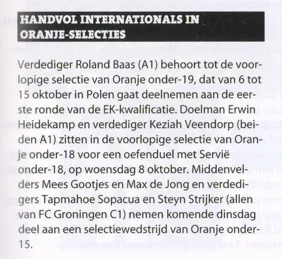
This list is a testament to the hard work of the youth coaches at the time. It is also historically significant because, just a few months after this programme was printed, the club would announce ‘Plan55’ and bring in Gerard Kemkers to completely restructure the academy, abolishing the traditional A1, B1, and C1 team structures.
A Look into the Future
By 2026, the careers of these young internationals have taken various paths, illustrating the unpredictable nature of youth football. Roland Baas made his first-team debut shortly after this announcement and went on to have a solid career in the Dutch lower leagues. Keziah Veendorp became a highly respected Eredivisie player, notably captaining FC Emmen before moving abroad. While not every name on this list became a global superstar, this 2014 news column captures a moment of pure, unadulterated potential—a time when these local boys were recognized as some of the best talents in the entire country.