Football history is full of sliding doors and “what if” moments, and matchday programmes are often the only physical evidence of paths not taken. On page 29 of the October 2013 FC Groningen booklet, the “Nieuws” section proudly lists the club’s academy players who had been called up to represent the Dutch national youth teams. Tucked into the middle of this paragraph is a name that will make modern football fans do a double-take: William Ekong.
The text notes: “Het Nederlands Beloftenelftal, met William Ekong op de voorlopige lijst, speelt in Brabant een vierlandentoernooi…” (The Dutch U20 team, with William Ekong on the provisional list, is playing a four-nation tournament in Brabant). Today, the footballing world knows him as William Troost-Ekong, the fierce, commanding center-back. But in 2013, as a young prospect trying to break into the Groningen first team, he was firmly embedded in the KNVB (Dutch FA) youth system, having represented the Netherlands at the U19 and U20 levels.
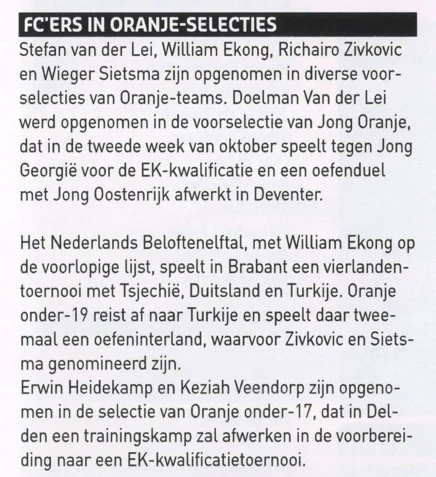
Born in the Netherlands to a Dutch mother and a Nigerian father, Troost-Ekong possessed dual nationality. This small printed block captures the twilight of his Dutch international career. It is a fascinating artifact showing a player caught between two footballing identities, right before he made the monumental decision that would define his legacy.
A Look into the Future
The young defender listed on this page as a Dutch youth prospect would eventually make a definitive choice. In 2015, William Troost-Ekong pledged his senior international allegiance to Nigeria. It proved to be a masterstroke. He didn’t just play for the Super Eagles; he became their iconic captain, leading the nation in multiple World Cups and Africa Cup of Nations tournaments, even scoring in the AFCON final. Looking back at this 2013 programme, it is surreal to see the future Nigerian legend casually listed as a provisional squad member for a minor Dutch youth tournament in Brabant.