The “News” section of a matchday programme often serves as a dry bulletin for administrative updates, but it can also act as a fascinating graveyard of “what-ifs” and future triumphs. In the March 2015 issue, ahead of the match against FC Twente, FC Groningen quietly announced a major squad clearing. The club confirmed that seven first-team players would not have their expiring contracts renewed.
Among the names listed were experienced cult hero Nick van der Velden, Paco van Moorsel, and a young, promising defender who was currently out on loan at FC Dordrecht: William Troost-Ekong.
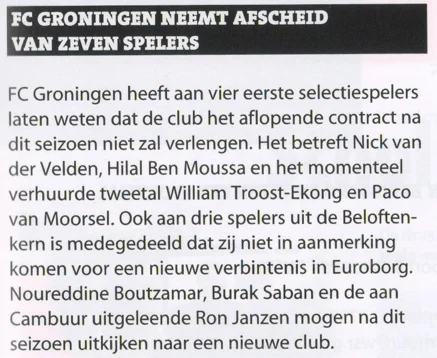
At the time, the release of Troost-Ekong seemed like standard housekeeping. The Dutch-born Nigerian center-back had struggled to break into a solid Groningen defense and had spent time gaining experience elsewhere. Releasing him was a pragmatic business decision for a club that constantly needed to refresh its academy-to-first-team pipeline. Right next to this announcement was another piece of significant club news: the arrival of Robey Sportswear as the new kit supplier for the 2015/2016 season. The club was preparing for a new era, both aesthetically and on the pitch, trimming the fat to make room for new talent.
A Look into the Future
The decision to release William Troost-Ekong is a classic example of how unpredictable football development can be. While Groningen moved on, Troost-Ekong’s career exploded. He went on to play in the English Premier League for Watford, became a stalwart in Serie A with Udinese and Salernitana, and most impressively, captained the Nigerian National Team at multiple Africa Cup of Nations tournaments, cementing himself as one of the most recognizable African defenders of his generation. Looking back at this tiny, unassuming text block from 2015, one can only marvel at the incredible global journey that began with a quiet departure from the Euroborg.