
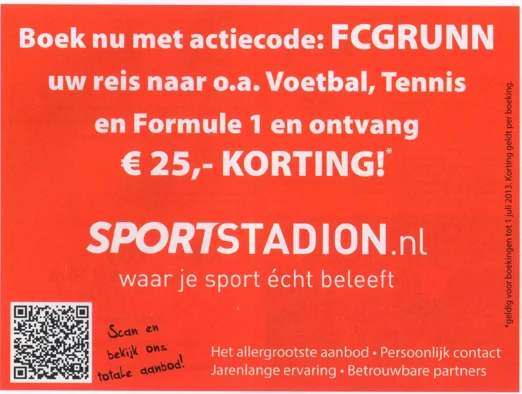
While the Euroborg is the undisputed temple of football in the northern Netherlands, the fans sitting in its stands are also consumers of global sports entertainment. The bright red advertisement for SPORTSTADION.nl on page 40 perfectly captures the growing trend of international sports tourism in the early 2010s.
The ad offers a €25 discount on trips to international football, tennis, and Formula 1 events, using a highly localized hook: the promo code “FCGRUNN”. By placing this ad in the matchday programme, the travel agency was acknowledging a simple truth: the passionate fan who spends their weekend watching FC Groningen is the exact same demographic willing to spend a small fortune to fly to Barcelona for El Clásico or travel to Spa-Francorchamps for a Grand Prix. Interestingly, the advertisement also features a prominent QR code with the instruction “Scan en bekijk ons totale aanbod!” (Scan and view our total offer!). In early 2013, QR codes in print media were still somewhat clunky, often requiring users to download a specific third-party scanning app, making this ad a fascinating artifact of early mobile marketing adoption.
A Look into the Future
Viewed from 2026, the two main elements of this advertisement have exploded in ways few could have predicted in 2013. First, the mention of “Formule 1” predates the absolute mania that would soon sweep the Netherlands with the rise of Max Verstappen. Sports travel agencies like the one advertised here would eventually build massive empires solely on organizing the “Orange Army” trips to F1 tracks around the globe. Secondly, the QR code—once a marketing gimmick that many tech analysts predicted would fail—became the absolute, ubiquitous standard for digital interaction following the global pandemic of the early 2020s. This ad was simply ahead of its time.