
Moving twenty thousand people in and out of the Euroborg area on a matchday has always been a complex logistical puzzle for the city. While the stadium was designed with modern infrastructure in mind, avoiding complete gridlock on the ring road required a decentralized approach. The 2015 matchday programme highlights the backbone of this strategy: the Pendelbusdienst (shuttle bus service).
In collaboration with Arriva Touring, FC Groningen continued its highly successful Park & Ride system to circumvent the traffic jams. Fans were directed to park on the outskirts of the city at three strategic nodes: P&R Hoogkerk on the A7 highway, P&R Haren on the A28, and the Sportcentrum Kardinge pickup point. For just 3 euros for a return ticket, supporters could board a shuttle every 15 minutes starting an hour and a quarter before kickoff, dropping them directly at the Boumaboulevard.
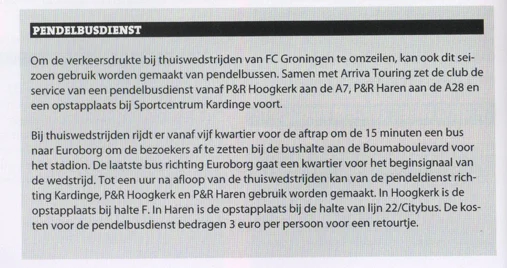
This system was more than just a convenience; it was a socio-environmental necessity. By intercepting cars at the city’s fringes, the club drastically reduced carbon emissions and localized congestion around the Europapark district. The strict parking hierarchy outlined on the same page—reserving the underground P1 for premium spots and pushing general fans to external lots or the NS-station Europapark bicycle parking—shows a mature, Dutch approach to urban crowd management.
A Look into the Future
By 2026, the transport landscape around the Euroborg has evolved further with the full electrification of the local bus fleet and the expansion of the Europapark train station. However, the foundational P&R strategy established in the 2010s remains virtually unchanged. The A7 and A28 nodes are still the primary gateways for rural fans commuting to the city, proving that the infrastructure planned over a decade ago was remarkably future-proof.