
For decades, the matchday experience in Groningen hasn’t ended with the final whistle; it merely transitions from the stands of the Euroborg to the bustling streets of the city center. Tucked away in the advertising grid on page 7 of the May 2013 programme is a stark, black-and-white ad for De Kar Bar-Dancing, located at Peperstraat 15.
The advertisement is beautifully straightforward, promising exactly what generations of students and football fans have sought: “Woensdag t/m Zondag van 22.00 tot laat!” (Wednesday to Sunday from 22:00 until late!). In an era where nightlife marketing was rapidly shifting to social media, De Kar relied on its established reputation, advertising a reliable mix of “80’s, 90’s, Pop, Rock, Dance, Alternative and Funk.” It was the kind of unpretentious, alternative venue where you could celebrate a thrilling FC Groningen victory or drink away the sorrows of a frustrating defeat, surrounded by the eclectic energy of a true university city.
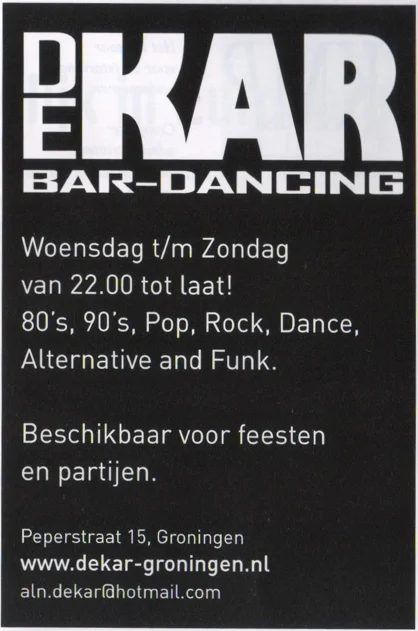
The presence of such a bar in the official club programme highlights the symbiotic relationship between the football club and local hospitality. De Kar wasn’t a massive corporate sponsor; it was a local institution reaching out to its natural demographic. The ad also mentions availability for parties and events, cementing its role as a communal gathering space in the heart of Groningen.
A Look into the Future
Fast forward to 2026, and the nightlife landscape of the Netherlands has faced immense challenges, from pandemic closures to rising operational costs. Yet, legendary alternative spots like De Kar hold a special place in the cultural memory of Groningen. Whether surviving through evolution or living on in the nostalgic tales of alumni and veteran supporters, the mention of the Peperstraat venue instantly transports fans back to the sticky floors, loud rock music, and late-night celebrations of the early 2010s.