While the VIP lounges of modern football stadiums are often filled with tech entrepreneurs and corporate executives, the true economic foundation of a regional club is found in its matchday programme advertisements. The ad pages surrounding the main interview in the September 2013 FC Groningen booklet provide a perfect snapshot of the province’s pragmatic, blue-collar economy.
Looking across pages 12, 15, and 16, there is a distinct lack of glamorous, abstract startups. Instead, the pages are dominated by the people who literally build and maintain the region. We see Jager & Zn advertising wooden pallets and IBC tanks. We see De Stucadoor (The Plasterer) offering their services. There is Bouwbedrijf R. van Tongeren from the village of Schildwolde, and Belisol selling aluminum and wooden window frames. Even the financial services are grounded in local reality, with Tirion Hypotheken (Mortgages) and a notary from Ter Apel.
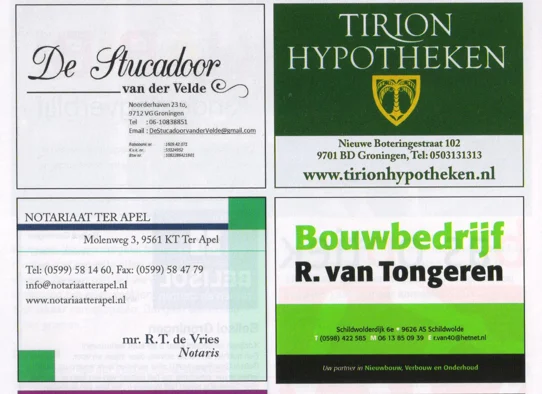
This is the B2B ecosystem of the north: practical, tangible, and hard-working. For a club that prides itself on the “Boeren” (Farmers/Workers) mentality, these sponsors are a perfect match. The fans sitting in the stands of the Euroborg weren’t just watching the game; they were looking at the companies that employed them, built their houses, and fixed their roofs.
A Look into the Future
The heavy concentration of construction, plastering, and housing-related businesses in these 2013 advertisements takes on a poignant historical significance when viewed from 2026. Shortly after this programme was printed, the province of Groningen entered a massive, decade-long crisis regarding earthquake damage caused by natural gas extraction. The local builders, plasterers, and window-fitters advertised on these pages would become the frontline workers in a massive, ongoing operation to reinforce and rebuild thousands of damaged homes across the region. The “blue-collar backbone” of the football club essentially became the backbone of the province’s physical recovery.