
Sometimes, an advertisement in a football programme captures a historical irony so profound that it belongs in a national museum. Page 31 of the August 2013 FC Groningen booklet features an advertorial from Gasunie, the Dutch natural gas infrastructure and transportation company. The headline asks a question that, in hindsight, carries an incredible amount of heavy historical baggage: “Hoe groen is gas?” (How green is gas?).
In 2013, the narrative presented in the text was standard corporate messaging. Gasunie argues that natural gas is the cleanest fossil fuel, producing the least CO2, and positions it as the ultimate, reliable bridge to a sustainable energy future. “We can always and everywhere rely on gas,” the text proudly proclaims, noting that it perfectly complements wind and solar energy. For decades, the extraction of natural gas from the massive Groningen gas field had been the economic bedrock of the Netherlands, and this ad reflects the absolute confidence of that era.
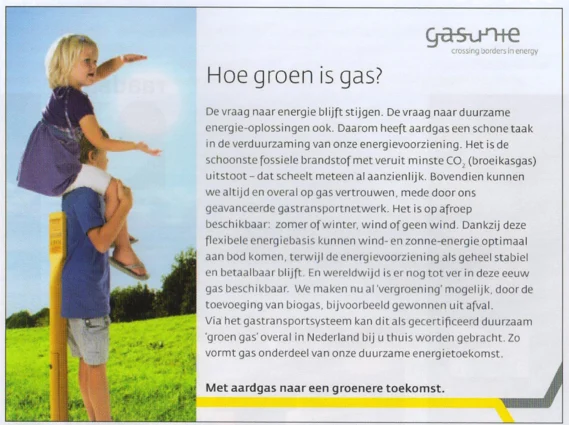
However, reading this in a stadium located in the heart of the Groningen province makes it a chilling time capsule. Just one year prior, in August 2012, the province had been hit by the Huizinge earthquake—the heaviest induced earthquake in Dutch history, directly caused by gas extraction. In 2013, the public anger was just beginning to boil over, but corporate messaging like this was still trying to hold the line.
A Look into the Future
The confidence radiating from this 2013 advertisement would soon collapse entirely. As the earthquakes in the Groningen province intensified, destroying thousands of homes and ruining lives, the public and political backlash became unstoppable. The phrase “we can always rely on gas” turned into a bitter irony for locals living in cracked houses. By the 2020s, the Dutch government made the historic decision to completely shut down the Groningen gas field. Gasunie itself had to radically pivot its entire corporate identity, transitioning away from natural gas to focus heavily on hydrogen and green energy networks. This single page in a football booklet perfectly captures the exact moment before the region’s economic and geological reality changed forever.