
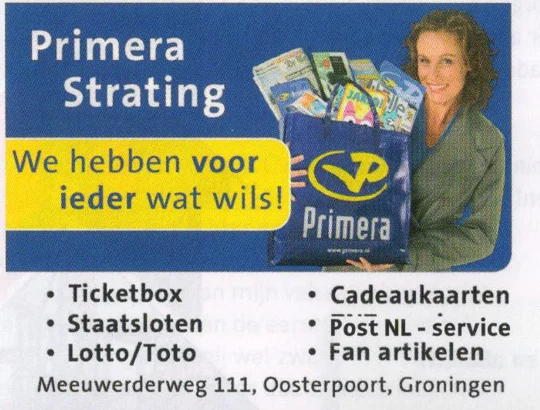
Before the smartphone became the undisputed center of the matchday experience, local neighborhoods relied on physical hubs to connect with their football club. Page 15 of the August 2013 FC Groningen programme offers a perfect window into this recent, yet rapidly fading, past through an advertisement for Primera Strating.
Located on the Meeuwerderweg in the Oosterpoort—a vibrant, traditionally working-class and student-heavy neighborhood just a stone’s throw from the city center—this tobacco and convenience store advertised itself as having “something for everyone.” Crucially, alongside Lotto tickets and postal services, they proudly advertised “Ticketbox” and “Fan artikelen” (Fan merchandise). In 2013, if you wanted to secure a seat at the Euroborg for a big match, you didn’t always log into an app; you walked down your local street, chatted with the shop owner, and bought a physical paper ticket printed right from the machine.
Surrounding this ad is a mosaic of the hyper-local service economy: Dakdekkersbedrijf Luit Groenewoud (roofers), Glazenwasserij Tolhuisen (window cleaners), and even a local denture clinic. These weren’t corporate sponsors; they were the everyday businesses of the people sitting in the stands, making the matchday programme a genuine reflection of the city’s working heartbeat.
A Look into the Future
By the 2020s, the concept of the “Ticketbox” at a local tobacco shop had been entirely rendered obsolete by digital ticketing, QR codes, and the club’s centralized online webshop. While the Oosterpoort neighborhood remains one of Groningen’s most lively and culturally rich districts, the physical ritual of buying a match ticket at the corner store has vanished. This small advertisement serves as a nostalgic reminder of a time when the football club’s commercial footprint was physically woven into the street corners of the city.