
When FC Groningen moved from the beloved, gritty Oosterpark to the modern Euroborg in January 2006, there were fears that the club might lose its soul in the concrete corridors of the new arena. Page 21 of the February 2014 matchday programme provides the definitive, statistical proof that those fears were entirely unfounded.
Under the header “TOESCHOUWERS IN EUROBORG” (Spectators in Euroborg), the editors published a comprehensive breakdown of the stadium’s attendance over its first eight years. The numbers are staggering for a provincial club. The text proudly announces that in 160 official matches, exactly 3,238,809 spectators had passed through the gates. The accompanying table breaks down the average attendance season by season, showing a remarkably consistent figure hovering around 20,000 to 22,000 fans per game.
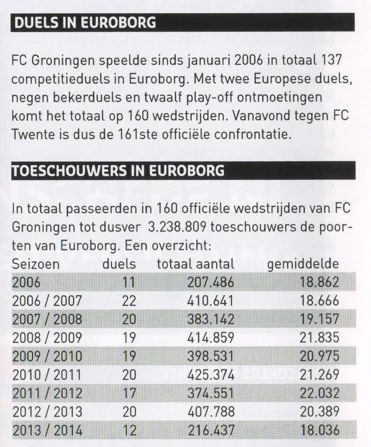
What makes this table so historically significant is the context of the era. Between 2008 and 2014, the Netherlands was navigating a severe economic recession. Discretionary spending dropped, and many Eredivisie clubs saw empty seats. Yet, the Euroborg remained packed. The table shows that even during the toughest economic years, the average attendance never dropped below 18,600. It proves that for the people of the northern provinces, a ticket to see the Pride of the North wasn’t a luxury; it was an absolute necessity.
A Look into the Future
The Euroborg (later renamed the Hitachi Capital Mobility Stadion and then the Euroborg once again) maintained its status as an impregnable fortress of attendance. Even when the club faced severe sporting crises in the 2020s—including a shocking relegation to the Eerste Divisie—the fans continued to show up in massive numbers, consistently selling out the stadium. The foundation of that unbreakable loyalty is printed right here in this 2014 table. It is the statistical proof that the club successfully transplanted its soul from the old stadium to the new one, creating a regional monopoly on sporting entertainment.