
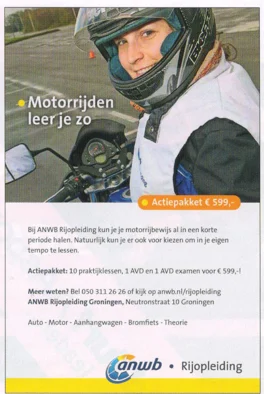
For many young fans standing in the Z-Side, the ultimate symbol of independence isn’t just seeing their team win; it’s getting their driver’s license. Tucked into the middle of page 42 is an advertisement for ANWB Rijopleiding, specifically promoting motorcycle lessons (“Motorrijden leer je zo”) at their local branch on the Neutronstraat in Groningen.
The ANWB (Royal Dutch Touring Club) is a massive, ubiquitous national institution in the Netherlands, but driving schools operate on a hyper-local level. Advertising in the FC Groningen matchday programme was a direct pitch to the young adult demographic—the 18-to-25-year-olds who had just scraped together enough money from their weekend jobs to afford lessons. The advertisement serves as a perfect economic time capsule, boldly offering an “Actiepakket” (Action package) of 10 practical lessons and two exams for exactly €599.
A Look into the Future
Looking at that €599 price tag from the perspective of 2026 induces a deep sense of economic nostalgia. Driven by inflation, rising fuel costs, and stricter examination requirements, the cost of obtaining a driver’s license in the Netherlands has skyrocketed over the last decade, often costing thousands of euros. Furthermore, urban mobility in Groningen has shifted dramatically towards high-speed e-bikes (fatbikes) and improved public transit, changing the traditional rite of passage. Yet, the ANWB remains a pillar of Dutch infrastructure, and the dream of cruising through the Ommelanden on a motorcycle still captures the imagination of the northern youth.