
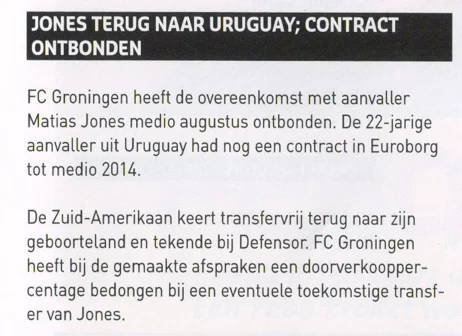
FC Groningen has built a formidable, globally recognized reputation for scouting and developing South American talent. The Euroborg has been a springboard for continental superstars. However, for every success story that makes the headlines, there is a quiet departure hidden in the news section of a matchday programme. Page 29 of the September 2013 edition documents exactly that with a small, sobering header: “JONES TERUG NAAR URUGUAY; CONTRACT ONTBONDEN” (Jones back to Uruguay; contract terminated).
The short paragraph explains that the club and 22-year-old Uruguayan attacker Matías Jones had mutually agreed to terminate his contract, which was originally set to run until mid-2014. The text notes he was returning to his homeland on a free transfer to join Defensor Sporting. When Jones originally arrived in Groningen in 2011 from Uruguayan side Danubio, he carried the heavy expectations that come with being a South American import at a club famous for them. But adapting to the physical, tactical, and cultural demands of the Eredivisie is notoriously difficult.
This small news snippet initially reads like a classic, somewhat melancholic tale of a failed European dream—a young man crossing the Atlantic, struggling for minutes, and quietly packing his bags to return to South America. But football careers rarely follow a straight line, and the story of Matias Jones and Dutch football was far from over.
A Look into the Future
While the 2013 matchday programme framed this as a final goodbye, it was merely the end of chapter one. Jones spent several years navigating the South American leagues, playing in Uruguay, Colombia, and Argentina. However, in 2019, he made a surprise return to the Netherlands, signing with SC Cambuur. He eventually found his true footing in the Dutch amateur and lower professional tiers, becoming a respected player for clubs like HHC Hardenberg and VV Hoogeveen well into the 2020s. Looking back at this 2013 announcement, it wasn’t the end of his Dutch dream; it was just a very long detour.