
When a football manager decides to “throw the helm around” and change a team’s tactical system, it is never just lines on a chalkboard; it profoundly impacts the careers of the players involved. In the November 2014 matchday programme, directly complementing manager Erwin van de Looi’s announcement of a shift to a 4-4-2 formation, the “De Hoofdrolspeler” feature focuses on the man who benefited most from this revolution: Michael de Leeuw.
The headline screams: “Dit systeem past mij perfect” (This system suits me perfectly). The interview chronicles De Leeuw’s frustrating start to the season. Having lost his top scorer status to young phenomenon Richairo Zivkovic the previous year, De Leeuw found himself on the bench at the start of the 2014/2015 campaign. He admits he even considered a transfer. However, he kept his head down and proved his worth as a super-sub, scoring crucial goals against Heracles, Ajax, and notably in the European qualifier against Scottish side Aberdeen.
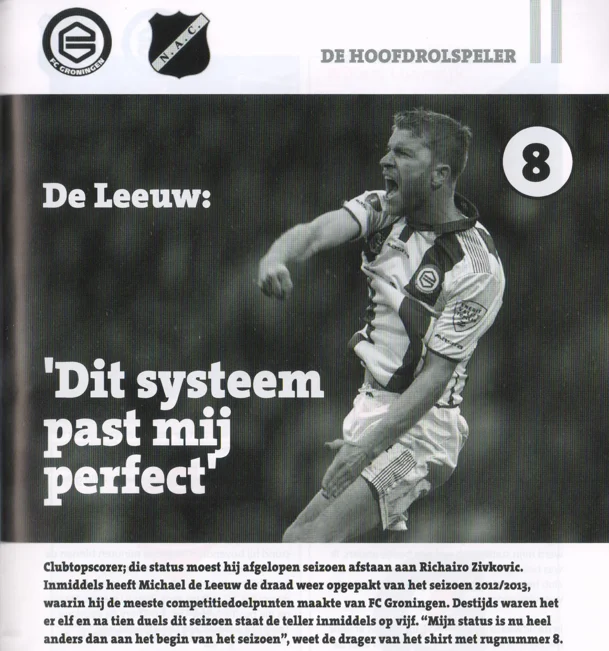
The core of the interview provides a fascinating tactical insight into squad building. De Leeuw explains why the old 4-3-3 system wasn’t working for him. “In the 4-3-3 system, I focused on the ’10’ position, behind striker Danny Hoesen. But Tjaronn Chery was preferred in that position,” he reveals. He also points out a crucial missing piece: “We don’t have a Filip Kostic this season, and he was very decisive with his actions.”
Without Kostic’s natural width, the 4-3-3 was stagnant. The switch to a 4-4-2 allowed De Leeuw to move up top and play alongside Danny Hoesen, rather than competing for the crowded number 10 role. “Danny Hoesen and I feel very comfortable with each other, and it’s great that we can show that now,” De Leeuw notes, celebrating the fact that both strikers scored in the recent match against AZ Alkmaar.
A Look into the Future
By 2026, Michael de Leeuw is remembered as one of the most intelligent and effective attackers in the modern history of FC Groningen. This specific tactical switch in the autumn of 2014 was the catalyst. Playing in that two-striker system, De Leeuw became the ultimate “Mr. 1-0,” possessing an uncanny ability to find space in the box and score crucial opening goals. He was instrumental in the team’s historic KNVB Cup victory later that season. After successful stints in the MLS with Chicago Fire and back in the Eredivisie with Willem II, he eventually returned to Groningen, cementing his legacy as a player whose tactical adaptability was just as sharp as his finishing.