
If you want to understand how a manager builds a team, look at the distribution of playing minutes. Page 21 of the October 2013 matchday programme features a fascinating statistical block titled “Negen uit Negen” (Nine out of Nine). It lists the only five FC Groningen players who had appeared in all nine Eredivisie matches up to that point in the season.
The list reveals the absolute, unbreakable spine of manager Erwin van de Looi‘s squad. Goalkeeper Marco Bizot and central defender Eric Botteghin had played every single second (810 minutes). Wingers Filip Kostic (796 minutes) and Giliano Wijnaldum (765 minutes) were the undisputed engines on the flanks. But the fifth name on the list tells a completely different, brilliant story of youth development: 16-year-old striker Richairo Zivkovic.
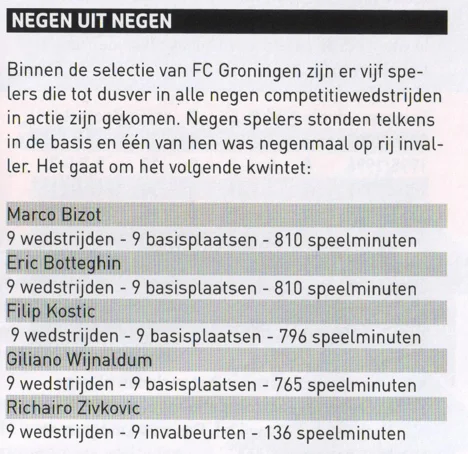
Zivkovic had also played in all nine matches, but his total playing time was a mere 136 minutes. He had zero starts and nine substitute appearances, averaging just over 15 minutes per game. Despite the massive media hype surrounding the teenager after he broke Arjen Robben’s youngest goalscorer record in August, the coaching staff refused to throw him into the deep end. They used him exclusively as a late-game impact sub, protecting him from the physical grind of 90-minute Eredivisie battles and the crushing weight of public expectations.
A Look into the Future
This strategy of drip-feeding minutes to a teenage prodigy was highly effective in the short term. Richairo Zivkovic thrived in his role as a super-sub, scoring crucial goals against tired defenses and earning a high-profile transfer to Ajax at the end of the season. However, his subsequent struggles to secure a starting spot in Amsterdam highlighted just how carefully FC Groningen had managed his environment in 2013. Meanwhile, the “ironmen” on this list—specifically Eric Botteghin and Marco Bizot—used those 810 minutes as the foundation for long, highly successful careers as undisputed starters in top European leagues.