Look closely at the advertising banners in any modern football stadium, and you will usually see global betting firms, airlines, and car manufacturers. But dive into the pages of a local matchday programme, and you discover the true, greasy gears of the regional economy. A large blue advertisement for FA. VAN KAMMEN offers a service that is the absolute, life-giving backbone of Dutch street and stadium culture: the buying, selling, and leasing of food trucks.
The list of available vehicles reads like a menu of pure, unfiltered Dutch comfort: Snackwagens, Oliebolwagens, Koelwagens, Loempiawagens, Kaaswagens. Every single fan who has ever walked toward the Euroborg on a freezing Sunday afternoon has interacted with the end product of this specific B2B industry. These are the trailers pumping out the smells of deep-fried eierballen, hot braadworst, and spring rolls, creating the sensory atmosphere of matchday.
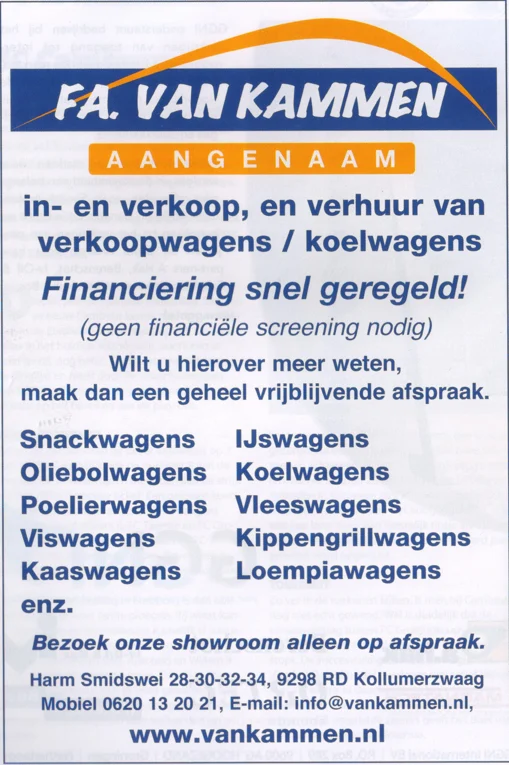
What makes this ad beautiful is its sheer pragmatism. “Financiering snel geregeld! (geen financiële screening nodig)” — rapid financing, no financial screening required. It is an open invitation to local entrepreneurs to hitch a Viswagen (fish truck) to their car and start selling herring outside the stadium gates. By placing this ad in the FC Groningen programme, the company from the Frisian village of Kollumerzwaag perfectly targeted the independent, blue-collar entrepreneurial spirit of the Northern match-going public.
A Look into the Future
By 2026, stadium catering has seen waves of modernization, with digital ordering apps, cashless systems, and gourmet food concepts entering the concourses. Yet, the charm and necessity of the traditional Snackwagen parked outside the stadium footprint remains utterly untouched. Companies like FA. VAN KAMMEN continue to thrive, supplying the rolling kitchens that feed the masses. The smell of frying fat from an authentic Oliebolwagen on a winter matchday is a cultural heritage that no amount of modern stadium gentrification can ever replace.