
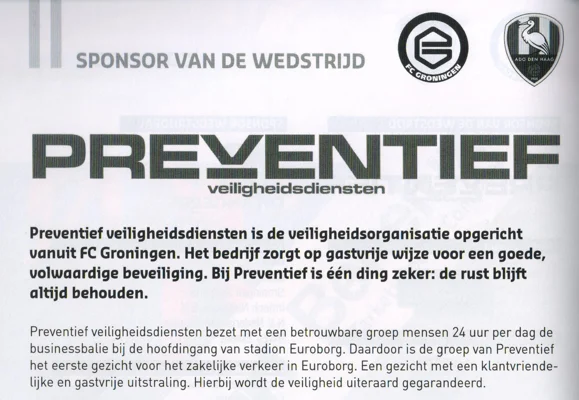
In modern football, stadium security is almost universally outsourced to massive, faceless private security corporations. However, page 26 of the December 2013 matchday programme reveals a fascinating, highly unusual business strategy employed by the Pride of the North. The “Sponsor of the Match” is a company called Preventief veiligheidsdiensten (Preventive Security Services). But read the first line of the text closely: “Preventief veiligheidsdiensten is de veiligheidsorganisatie opgericht vanuit FC Groningen.” (Preventive security services is the security organization founded from within FC Groningen).
Instead of hiring an external firm to guard the Euroborg, the club literally built its own. The article explains the philosophy behind this move. They didn’t just want bouncers; they wanted hosts. The company was tasked with manning the business desk at the main entrance 24 hours a day, ensuring a “customer-friendly and hospitable appearance.” The vision was clear: security should be invisible until needed, allowing the organization’s processes to run undisturbed.
By bringing security in-house, the club ensured that the people guarding the doors shared the exact same cultural DNA and hospitality standards as the club itself. It was a brilliant way to control the matchday environment from the moment a VIP or a fan stepped onto the stadium footprint, turning a mandatory operational cost into a dedicated, club-aligned business unit.
A Look into the Future
The concept of “hospitality security” outlined in this 2013 advertorial became the absolute gold standard for European stadiums over the next decade. As football clubs increasingly relied on lucrative VIP boxes and corporate networking events to drive revenue, the traditional, aggressive “bouncer” mentality was entirely phased out in favor of highly trained, communicative security hosts. FC Groningen‘s decision to incubate its own security culture internally proved that they understood the evolving commercial landscape of the modern stadium experience long before many of their peers.