
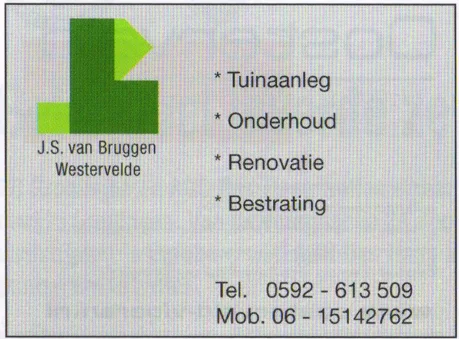
To truly grasp the geographical magnitude of FC Groningen, you have to look at the addresses in their advertising grid. In the top left corner of page 7, a simple, green-and-grey advertisement for J.S. van Bruggen offers standard landscaping services: garden design, maintenance, renovation, and paving. But the location listed is what makes it special: Westervelde.
Westervelde is a tiny, ancient esdorp (a traditional farming village) in the province of Drenthe, located near Norg. Its population hovers around 150 people. The fact that a local landscaper and paver from a village of 150 people in a neighboring province buys advertising space in the Euroborg is a stunning testament to the club’s regional monopoly. For rural craftsmen like van Bruggen, the football stadium in the city is the ultimate commercial megaphone. It is the one place where the entire northern population—from city executives to rural homeowners—gathers in one place, making it the perfect platform to secure paving contracts across the region.
A Look into the Future
By 2026, the landscaping and paving industry in the Netherlands has been forced to adapt to the realities of climate change. The traditional Dutch love for fully paved, maintenance-free gardens (often jokingly called “tegeltuinen” or tile gardens) has been heavily discouraged by municipalities due to severe urban flooding during heavy rains. Today, landscapers like those from Westervelde are at the forefront of the “climate-adaptive” garden movement, removing tiles and installing specialized drainage systems to help the soil absorb rainwater. The rural craftsmen who advertised their paving skills in 2013 are now the essential workers helping the region adapt to a changing climate.