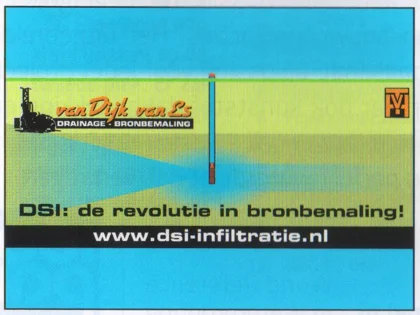
If you want to understand the unique challenges of the Dutch economy, you only need to look at the bottom left corner of the advertising grid on page 49. Here, a company named van Dijk van Es advertises a highly specific service: “DSI: de revolutie in bronbemaling!” (DSI: the revolution in dewatering!).
In almost any other country, a football matchday programme wouldn’t feature an advertisement for groundwater extraction. But in the Netherlands, where much of the land sits below sea level, bronbemaling is the absolute prerequisite for any construction project. Before you can lay a foundation for a house, a factory, or a stadium like the Euroborg, you must continuously pump the groundwater away to keep the building trench dry. By advertising their “revolution” in infiltration and dewatering to the FC Groningen crowd, van Dijk van Es was directly targeting the major real estate developers, civil engineers, and municipal planners sitting in the business lounges. It is a gritty, highly technical B2B pitch hidden in plain sight among the consumer ads.
A Look into the Future
By 2026, water management in the Netherlands has transitioned from a standard construction hurdle into a critical climate emergency. With increasingly extreme weather patterns causing both severe droughts and sudden floods, the extraction and infiltration of groundwater are now heavily regulated by local water boards (waterschappen). The “revolution” advertised in 2013—which likely referred to returning extracted water back into the soil rather than dumping it into the sewer—has become a mandatory ecological standard. Companies specializing in bronbemaling are no longer just construction facilitators; they are vital players in preserving the delicate hydrological balance of the Groningen province.