
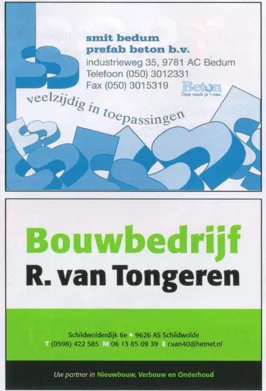
The advertising pages of the FC Groningen matchday programme often serve as a directory of the region’s heavy industry. On page 32 of the May 2013 edition, two adjacent advertisements perfectly illustrate the rural, blue-collar backbone of the northern Dutch economy: smit bedum prefab beton b.v. and Bouwbedrijf R. van Tongeren.
These are not glamorous B2C brands; they are the literal building blocks of the province. Smit Bedum, located in the town of Bedum (famous as the birthplace of Arjen Robben), specializes in prefabricated concrete, a crucial component for modern Dutch infrastructure and agricultural expansion. Right below them is Bouwbedrijf R. van Tongeren, a construction firm from Schildwolde. The presence of these companies in the Euroborg highlights a key demographic reality: the business lounges of the stadium are heavily populated by contractors, developers, and rural entrepreneurs who rely on local B2B networking to secure regional building projects.
A Look into the Future
By 2026, the construction and concrete industries in the Groningen region have undergone a massive, forced evolution. The escalating seismic crisis caused by gas extraction meant that traditional building methods were no longer sufficient. Companies like those from Bedum and Schildwolde had to rapidly adapt to strict new earthquake-resistant building codes (NPR 9998). The “versterkingsoperatie” (reinforcement operation) turned the entire province into a highly specialized construction zone, making the local expertise of rural builders more critical—and lucrative—than ever before.