
Following the progress of a club’s youth academy through the matchday programme often reveals the unglamorous, pragmatic realities of grassroots football. Page 59 of the May 2014 edition focuses on the FC Groningen D1 team (Under-13s), managed by Arjen Jorritsma. While the team finished a respectable 6th in the Eerste Divisie C, the editorial text highlights a bizarre logistical quirk from their final weeks of the season.
The text notes a 6-0 victory over NEC, followed by a 2-2 draw against De Graafschap. But the author adds a fascinating detail about that draw: “Bijzonderheid aan deze wedstrijd was dat het duel op Corpus den Hoorn werd gespeeld, ondanks dat het een uitwedstrijd betrof.” (A peculiarity of this match was that the duel was played at Corpus den Hoorn, despite it being an away match).
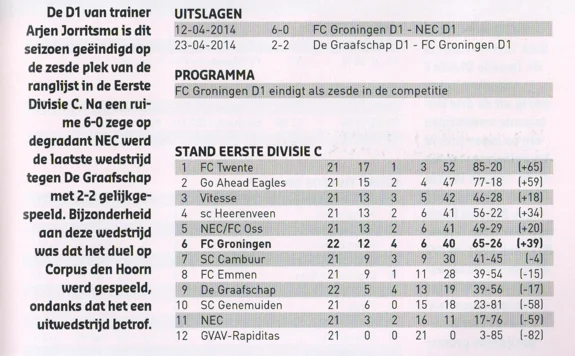
Corpus den Hoorn is, of course, the official training complex of FC Groningen. For reasons likely related to pitch availability, scheduling conflicts, or travel logistics for the opponents, the 12-year-old boys of Groningen found themselves hosting their own “away” game in their own backyard. It is a charming reminder that below the highly polished, multi-million-euro environment of the Eredivisie, youth football still relies on pragmatic compromises to get the games played.
A Look into the Future
The boys posing in the D1 team photo on this page were roughly 12 or 13 years old in 2014. By 2026, they are in their mid-twenties. The statistical reality of academy football dictates that only a tiny fraction of them ever made it to the professional ranks. For the vast majority, their time at Corpus den Hoorn was a fleeting childhood dream. But regardless of where their careers took them, they will always have this printed page as proof that they once wore the green and white stripes, navigating the quirky, unpredictable world of elite youth development.