
In early 2014, FC Groningen proved that its commitment to the region went beyond football. Page 29 of the matchday programme documents a pioneering moment in Dutch sports infrastructure: the installation of a massive solar power plant on the roof of the Euroborg.
Under the headline “ZONNECENTRALE OP DAK VAN EUROBORG”, the news block reveals that on January 14, 2014, the first of 531 solar panels was placed. This wasn’t just a corporate project; it was a community effort. Through a successful crowdfunding campaign organized by Stichting 1miljoenwatt and club sponsor Essent, over two hundred local residents and fans actually bought individual panels, becoming literal stakeholders in the stadium’s energy future.
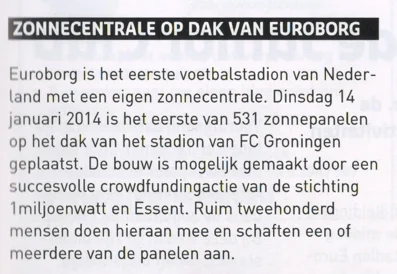
This move made the Euroborg the first football stadium in the Netherlands to house its own large-scale solar power plant. In a province deeply defined by its relationship with energy—specifically the extraction of natural gas—this pivot to “green” electricity was a powerful symbolic statement of modernization and sustainability.
A Look into the Future
The 531 panels installed in 2014 were just the beginning. By 2026, the Euroborg has become a model for sustainable stadium management across Europe. As the province of Groningen officially ceased natural gas extraction due to the seismic crisis, the stadium’s early adoption of solar technology looks visionary. Today, the “Green Cathedral” isn’t just a nickname based on the club’s colors; it is a literal description of one of the most energy-efficient sports venues in the country.