
If you read the matchday programmes from September and October 2013, the narrative surrounding FC Groningen was one of wild unpredictability. The team was scoring freely but leaking goals, collecting red cards at an alarming rate, and struggling for consistency. However, by the time the November 3rd edition against Roda JC went to print, the tone in manager Erwin van de Looi‘s column had completely transformed. The chaos had been replaced by cold, hard stability.
Under the confident headline “Steeds meer vastigheden” (More and more certainties), Van de Looi reflects on a spectacular run of form. The team had just secured massive home victories against AZ Alkmaar and PSV, followed by a gritty 2-2 draw away at Vitesse where they fought back from a 2-0 deficit. “We are unbeaten in three consecutive league matches and are only one point away from the top position in the Eredivisie,” he writes. The manager notes that the squad is finally gelling, creating recognizable patterns of play, and developing a “luxury problem” of having multiple reliable options for every position.
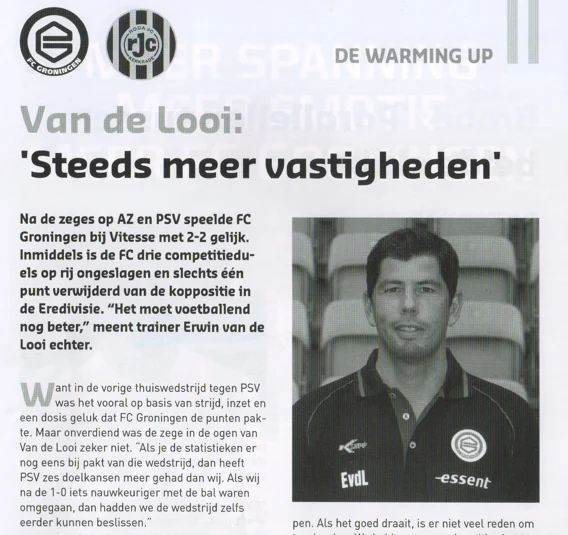
This column marks the exact turning point of the season. The tactical tinkering and disciplinary lectures of the early autumn had finally paid off. Van de Looi was no longer a rookie manager trying to put out fires; he was the architect of a well-oiled machine that was legitimately threatening the traditional top clubs of Dutch football.
A Look into the Future
The “certainties” that Van de Looi wrote about in November 2013 became the bedrock of his managerial legacy at the Euroborg. By finding his optimal starting eleven and instilling tactical discipline, he forged a squad that was incredibly difficult to beat. This exact foundation of defensive solidity and clinical counter-attacking would reach its absolute pinnacle a year and a half later, when this core group of players marched to the De Kuip stadium and won the 2015 KNVB Cup. The growing pains were over; the golden era of Van de Looi’s tenure had officially begun.