
Football history is rarely made under the bright lights of a cup final; it is usually forged in the muddy, unglamorous reality of mid-season friendlies. In the “De Warming Up” column of the October 19, 2014 matchday programme, FC Groningen manager Erwin van de Looi provided a fascinating glimpse into the exact moment he decided to change the club’s tactical DNA.
Despite sitting in a respectable 9th place and remaining unbeaten at the Euroborg (including a recent 1-0 win over Willem II), Van de Looi was deeply dissatisfied. “The shown play gave insufficient reason to build upon,” he bluntly admitted to the fans. The team had just suffered a heavy defeat to Feyenoord, and the manager knew a radical shift was required. He used the October international break to conduct a secret laboratory experiment across the border.
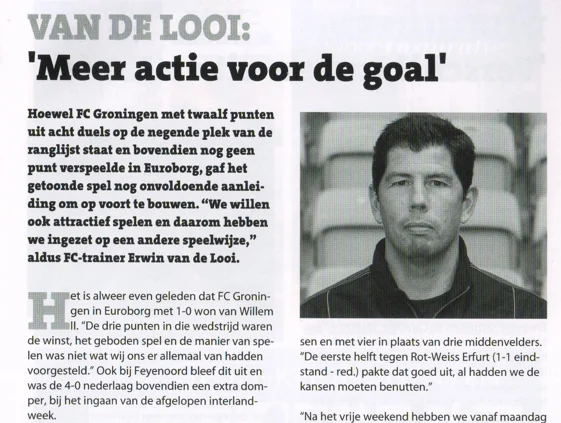
“In Erfurt, FC Groningen played a friendly match with two instead of three strikers and with four instead of three midfielders,” Van de Looi revealed, referencing a 1-1 draw against the German lower-league side Rot-Weiss Erfurt. “That worked out well, although we should have utilized the chances.” He announced to the home crowd that following this experiment, the team had extensively discussed the new playing style and would be implementing it against Excelsior. It was the public birth of the 4-4-2 system.
A Look into the Future
Viewed from the perspective of 2026, this column is a crucial historical document. The “Erfurt Experiment” was the catalyst for the greatest season in the club’s history. The 4-4-2 system that Van de Looi nervously introduced to the fans on this page would eventually become a well-oiled machine, providing the defensive solidity and counter-attacking punch needed to win the 2015 KNVB Cup. It proves that sometimes, a meaningless 1-1 draw in a German provincial town can be the most important match of a club’s entire decade.