
When a manager decides to overhaul his team’s tactical system, the ripple effects are felt not just in his own dressing room, but in the opposition’s scouting department. Page 6 of the October 2014 matchday programme perfectly illustrates this dynamic through an interview with Excelsior manager Marinus Dijkhuizen.
Dijkhuizen arrived at the Euroborg managing a newly promoted side that was punching above its weight. He candidly admitted the disparity in experience, noting that aside from veteran goalkeeper Gino Coutinho, his squad was largely composed of young players fresh out of the Jupiler League. Facing an unbeaten FC Groningen at home was already a daunting task, but Dijkhuizen revealed an extra layer of anxiety caused by his counterpart, Erwin van de Looi.
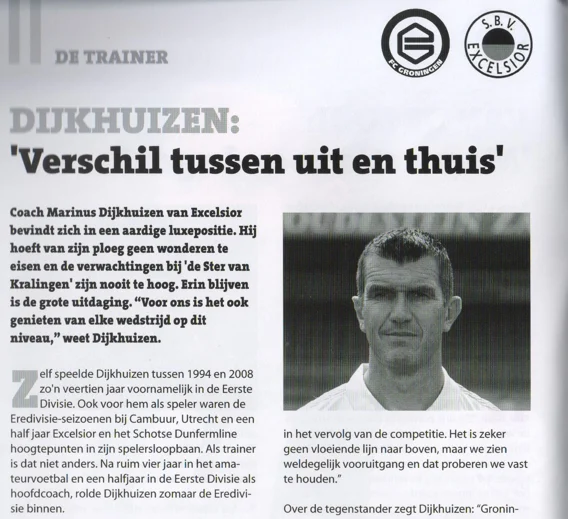
Word of Groningen’s “Erfurt Experiment” and their impending switch to a 4-4-2 formation had clearly reached the Excelsior camp. “That they are going to try a different playing system makes the preparation a bit more difficult for us,” Dijkhuizen confessed to the programme’s writers. “We have less to rely on from the analysis of the first eight matches.” It is a brilliant, honest admission of how tactical unpredictability can neutralize an opponent’s preparation before a ball is even kicked.
A Look into the Future
By 2026, Marinus Dijkhuizen is remembered for his impressive work keeping Excelsior in the Eredivisie, which eventually earned him a high-profile (though short-lived) move to Brentford in the English Championship. His quotes in this 2014 programme highlight exactly why the Euroborg was such a fortress that season. Van de Looi’s tactical shift didn’t just improve Groningen’s balance; it actively disrupted the scouting reports of every visiting team. The confusion Dijkhuizen felt that week was shared by many managers who traveled to the North during that historic cup-winning campaign.