By 2015, the province of Groningen was standing at a critical crossroads. The socio-economic fabric of the region was deeply intertwined with the extraction of natural gas, but the increasing frequency of earthquakes had forced the city to aggressively pivot towards sustainable alternatives. This monumental shift was vividly reflected in the matchday programmes at the Euroborg, where local educational institutions took out full-page ads not just to recruit students, but to promote a new regional identity.
A striking advertisement from Hanzehogeschool Groningen featured on page 15 highlights the Energy Academy Europe and their innovative test facility, EnTranCe. The centerpiece of the ad is a call to action: “Groen is ook ons doel!” (Green is also our goal!), accompanied by an image of students standing in front of a unique architectural project called the EnergyBarn.
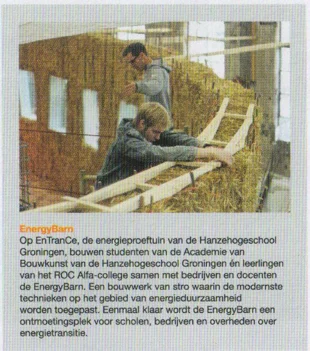
The EnergyBarn was a powerful symbol of grassroots sustainability. Built by students from the Hanzehogeschool Academy of Architecture and the ROC Alfa-college, it was constructed primarily from straw bales. This structure wasn’t just an academic exercise; it served as a functional meeting place for schools, businesses, and government bodies on the Zernike Campus to collaborate on the energy transition. The presence of such an ad in a football programme underscores how deeply the mission to redefine Groningen as a hub for renewable energy had permeated mainstream local culture.
A Look into the Future
From the vantage point of 2026, the EnergyBarn experiment was a humble yet prophetic step. The gas tap in Groningen has since been definitively closed, ending an era of extraction that defined the region for decades. The Zernike Campus has expanded into one of the most advanced energy research hubs in Europe. The students who built that straw barn in 2015 are now the engineers and policymakers navigating the complex realities of the global climate crisis, proving that the foundation for a sustainable future was quietly being laid during Sunday afternoon football matches.