Page 6 of the matchday programme offers a perfect time capsule of the Dutch and European football landscape in May 2013. The “De Tegenstander” (The Opponent) section profiles Ajax, who arrived at the Euroborg having secured their 32nd national title just seven days prior. The text draws a direct line between the current squad managed by Frank de Boer and the legendary 1996 generation under Louis van Gaal, noting that the current players were “barely out of diapers” during that mid-90s golden era.
What makes this page fascinating for football historians is its commentary on the shifting power dynamics in the Eredivisie. The author notes that after years where clubs like AZ and FC Twente broke the traditional top-3 dominance, the old order was largely restored. The programme uses the acronym “PAF” (PSV, Ajax, Feyenoord) to describe this traditional elite, pointing out that these three clubs, boasting the highest budgets, were set to finish in the top three spots for the first time since the 2003/2004 season.
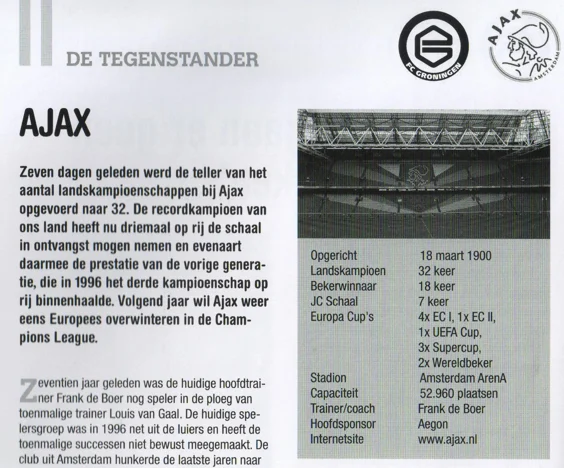
The European recap is equally nostalgic. The text proudly mentions that Ajax finished third in a brutal Champions League group featuring Real Madrid, Borussia Dortmund, and Manchester City. It highlights that two of those opponents (Dortmund and Bayern Munich, who beat Madrid) were set to face off in the upcoming Wembley final on May 25. Meanwhile, Ajax’s European journey ended against Steaua Boekarest in the Europa League. This single column of text perfectly encapsulates a highly specific era of European football, right before the financial gap between the Eredivisie and the Premier League became an insurmountable chasm.
A Look into the Future
By 2026, the concept of the “PAF” hegemony has experienced numerous turbulent chapters. While Ajax and PSV largely maintained their financial and sporting dominance over the following decade, clubs like AZ and a resurgent FC Twente continuously challenged the status quo, proving that the traditional top-3 is never entirely safe. Furthermore, the Champions League format mentioned here—with its classic four-team group stages—has been entirely replaced by the “Swiss model,” making the 2012/13 European campaign a relic of a bygone UEFA era.