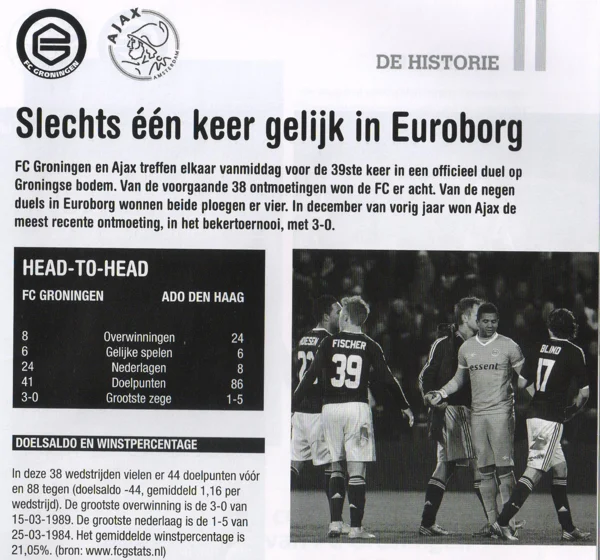
One of the greatest charms of collecting physical matchday programmes is discovering the permanent, unchangeable human errors that slipped past the editors. Pages 9 and 10 of the May 2013 edition, meant to detail the historical statistics between FC Groningen and Ajax, feature a spectacular copy-paste blunder that immortalizes the stressful, deadline-driven reality of print media.
The right page (page 9) boldly declares the history of matches at the Euroborg. However, if you look closely at the “HEAD-TO-HEAD” black statistics box, the opponent listed next to FC Groningen is not the Amsterdam club, but ADO Den Haag! The editors clearly used the layout template from the previous home game and simply forgot to update the header. The comedy of errors continues down the page. Under the “MEEST RECENTE WEDSTRIJD” (Most Recent Match) section, the text correctly identifies a 0-3 loss to Ajax in December 2012. But right below it, the lineup header screams “OPSTELLING ADO DEN HAAG,” followed immediately by a list of famous Ajax players like Christian Eriksen, Viktor Fischer, and Jasper Cillessen.
The mistake spills over onto page 10 as well, where a historical 2-2 draw from August 2010 is highlighted. Once again, the away team’s lineup is confidently titled “OPSTELLING ADO DEN HAAG,” despite listing Amsterdam legends like Maarten Stekelenburg and Jan Vertonghen. For a collector, these glaring typos are absolute gold—a reminder that before the era of instant digital corrections, a mistake sent to the printing press was a mistake forever.
A Look into the Future
In 2026, matchday information is predominantly consumed via official club apps and social media platforms. If a graphic designer makes a typo in a digital lineup graphic today, it is deleted and re-uploaded within seconds, leaving no trace of the error. The permanence of print is what makes physical programmes so valuable to historians. This specific 2013 booklet will forever insist that ADO Den Haag somehow fielded the reigning Eredivisie champions’ squad.