
Football fans are deeply superstitious, and certain stadiums hold psychological hexes over specific opponents. Page 10 of the September 2014 matchday programme highlights one of the most enduring curses in modern FC Groningen history: the absolute inability of Willem II to conquer the Euroborg.
The headline of the “De Historie” section is blunt and triumphant: “Willem II won nog nooit in Euroborg” (Willem II has never won in Euroborg). The text details the head-to-head statistics, noting that out of the previous encounters on Groningen soil, the home team had heavily dominated. To find the last time the team from Tilburg traveled back to Brabant with three points, you had to look past the modern concrete and green seats of the Euroborg, all the way back to the 2003/2004 season.
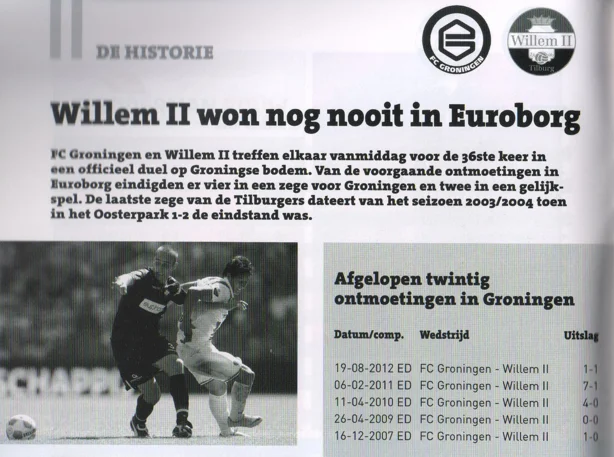
That last victory (a 1-2 defeat for Groningen) took place in the legendary, gritty Stadion Oosterpark. Since moving to their new home in 2006, Groningen had turned the venue into an impenetrable fortress against this specific opponent. The statistical table printed on the page lists a string of comfortable home victories, including a massive 7-1 demolition in 2011 and a 4-0 thrashing in 2010. For the visiting players stepping off the bus, the weight of that history must have felt suffocating.
A Look into the Future
By 2026, the aura of the Euroborg has seen its peaks and valleys, but the historical dominance over certain mid-table rivals remains a point of immense local pride. While all streaks are eventually broken in football, the psychological barrier documented on this 2014 page highlights exactly why away days in the far north of the Netherlands are universally dreaded by Eredivisie clubs. The transition from the Stadion Oosterpark to the modern arena didn’t just upgrade the facilities; for clubs like Willem II, it built a wall they spent over a decade trying to climb.