
Sometimes, the most fascinating historical documents are hidden in the margins of a statistics page. On page 21 of the September 2013 FC Groningen programme, under the unassuming header “Op één na de jongste” (The second youngest), there is a complete list of all 18 Eredivisie head coaches and their birthdates. The purpose of the list was to highlight that Groningen’s Erwin van de Looi (born in 1972) was the second-youngest manager in the league, trailing only ADO Den Haag’s Maurice Steijn.
However, when you read the rest of the names on this list, it becomes a breathtaking snapshot of Dutch football royalty. Managing Ajax was Frank de Boer. At Feyenoord? Ronald Koeman. Leading Vitesse was Peter Bosz. And sitting on the bench for Groningen’s fierce northern rivals, sc Heerenveen, was none other than Marco van Basten.
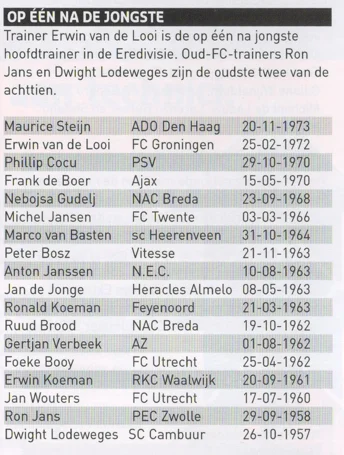
This small table captures a unique transitional era in Dutch football. You had the heroes of the 1988 European Championship (Van Basten, Koeman) testing their tactical wits against a new, younger generation of laptop-era coaches and pragmatic tacticians like Van de Looi and Steijn. For a fan reading this in the stands, it was just a fun trivia fact. For a historian, it is a masterclass in coaching pedigree.
A Look into the Future
The trajectories of the men on this list are staggering. Ronald Koeman would go on to manage Barcelona and the Dutch National Team. Peter Bosz would reach a European final with Ajax and manage Borussia Dortmund and PSV. Frank de Boer would experience a rollercoaster career across Europe and the national team. And the youngest man on the list, Maurice Steijn, would eventually find himself in the pressure cooker of managing Ajax a decade later. This simple printed list from 2013 is essentially the blueprint of Dutch football leadership for the next fifteen years.