A football stadium is the largest gathering place in any city, and its utility should extend far beyond the 17 home league matches a year. Page 13 of the December 19, 2013 matchday programme provides a heartwarming example of FC Groningen stepping up to fulfill its civic duty when the local government fell short.
Under the headline “NIEUWJAARSFEEST GRONINGEN 2014” (New Year’s Party Groningen 2014), the news block reveals a local drama. The municipality of Groningen had cancelled the traditional city-wide New Year’s Eve celebration. Unwilling to let the city ring in the new year in silence, local promoter Dis Istha took the initiative to organize an alternative. FC Groningen immediately offered the Euroborg stadium as the venue. The text notes that the “Night Mayor” of Groningen, Chris Garrit, along with other local figures, would provide the programming.
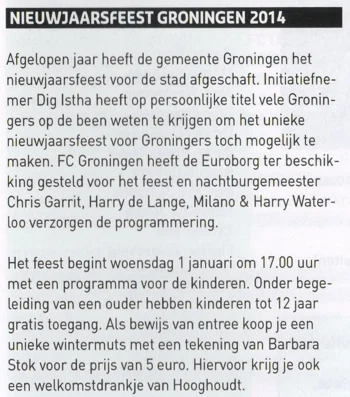
The event was designed to be highly accessible. Starting at 17:00 on January 1st, the entrance fee was a mere €5. But the true northern charm is found in the perks: the entrance fee included a unique winter hat (muts) and a welcome drink from Hooghoudt, the legendary local distillery. Children under 12 were allowed in for free. By opening its doors, the club transformed a potential civic disappointment into a massive, unified community celebration.
A Look into the Future
The decision to host the New Year’s party solidified the Euroborg‘s reputation not just as a sports venue, but as the true living room of the city. By 2026, the concept of stadiums hosting massive civic and cultural events is standard practice, but Groningen’s quick reaction to save the 2014 celebrations showed a deep, proactive care for its citizens. The local brand Hooghoudt remains a staple of northern hospitality, and the Euroborg continues to be the ultimate gathering place for the Pride of the North, whether they are cheering for a goal or counting down to midnight.