
A football stadium is one of the few remaining places in modern society where people from every socio-economic background, neighborhood, and profession gather in one place. The local municipality of Groningen clearly understood this in 2013. Taking up the entirety of page 23 is a bright, photo-filled advertisement for the Centrum voor Jeugd en Gezin (CJG) — the Center for Youth and Family.
This is not a commercial pitch; it is a vital piece of social infrastructure. The ad addresses “ordinary questions about raising and growing up,” offering support to parents who might be doubting their child’s development or simply needing advice. Placing this in the FC Groningen matchday programme was a highly targeted strategy to reach young fathers and families who might not actively seek out municipal health websites but would read every page of their football booklet before kickoff.
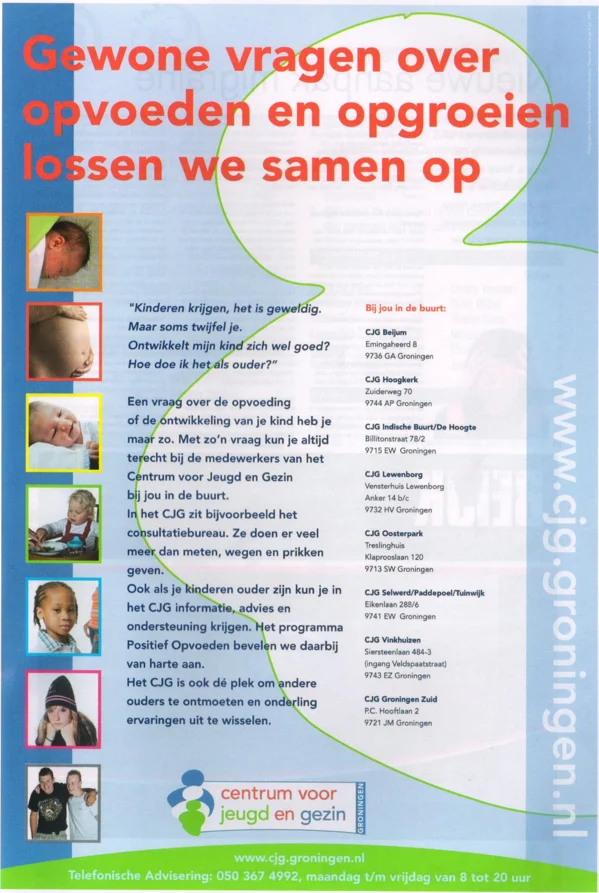
What makes this page a true historical treasure is the column on the right side: “Bij jou in de buurt” (Near you). It lists the addresses of the CJG branches, effectively drawing a demographic map of the club’s local fanbase. The list includes Beijum, Hoogkerk, Indische Buurt, De Hoogte, Lewenborg, Oosterpark, Selwerd, Paddepoel, Tuinwijk, Vinkhuizen, and Groningen Zuid. These are the working-class and middle-class arteries of the city. By listing these specific neighborhoods, the programme roots the football club deeply into the everyday, domestic reality of its supporters.
A Look into the Future
Looking back from 2026, the way municipalities communicate with citizens has become overwhelmingly digital, relying on targeted social media campaigns and centralized apps. However, the physical neighborhood centers listed in this 2013 advertisement remain crucial lifelines for community health and social work. The strategy of using the unifying power of the local football club to destigmatize asking for parenting help is a testament to the club’s role as a pillar of the community—a role that has only expanded in recent years through the club’s own dedicated social foundations.