A football club’s team bus is a rolling billboard, a highly visible symbol of the club’s identity as it travels across the country. In early 2014, FC Groningen decided to hand the creative control of this massive canvas directly over to the supporters. Page 29 of the March matchday programme announces the winner of this unique, crowdsourced design competition.
Under the headline “WINNEND BUSONTWERP VAN HOUTEN” (Winning bus design by Van Houten), the club reveals that local fan Rick van Houten had won the contest to design the new players’ bus. The process was a perfect example of modern digital engagement: a jury selected three final designs, which were then put to a public vote on Facebook. A total of 1,569 votes were cast, with Van Houten’s design securing 43 percent of the total.
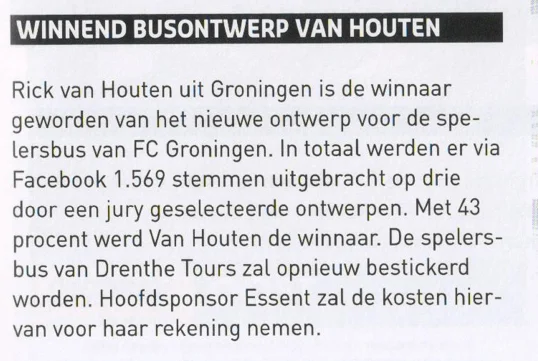
The text notes that the bus, operated by local partner Drenthe Tours, would be wrapped in the new design, with main sponsor Essent generously covering the costs. This initiative was a brilliant piece of community building. It ensured that every time the players traveled to an away game, they were literally riding inside a piece of art created and chosen by the very people who stood on the terraces.
A Look into the Future
Crowdsourcing designs—whether for team buses, third kits, or stadium murals—became a highly popular engagement tool for football clubs worldwide in the late 2010s and 2020s. FC Groningen‘s decision to use Facebook for this vote in 2014 shows them actively embracing the power of social media to foster a deeper connection with the fanbase. The bus designed by Rick van Houten carried the team for several seasons, serving as a rolling testament to the club’s philosophy that the fans are the true owners of the club’s identity.