
A modern football stadium must be more than just a pitch surrounded by seats; it must be an economic engine for the city. Page 26 of the August 2013 matchday programme perfectly illustrates how FC Groningen leveraged its infrastructure, featuring a massive advertisement for the “De Helden van Amstel Live!” concert.
Scheduled for Saturday, September 7th, the event wasn’t taking place inside the stadium, but rather on “P2 van Euroborg”—one of the massive parking areas surrounding the complex. The ad boldly claims it will be “the biggest Amstel pub in the Netherlands,” featuring a lineup of Dutch pop-rock heavyweights like VanVelzen, DI-RECT, and Trijntje Oosterhuis.
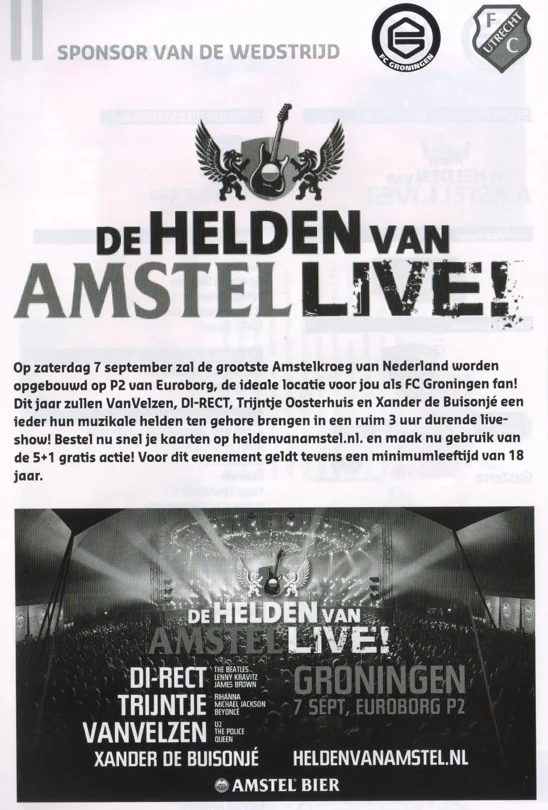
This full-page spread is a testament to the vision behind the Euroborg project. When the club moved from the residential Oosterpark to the industrial outskirts, the goal was to create a multi-purpose entertainment hub. By hosting massive, 3-hour live music events on its footprint, the stadium complex cemented its status as the cultural epicenter of the northern provinces, drawing in thousands of people who might never otherwise attend a football match.
A Look into the Future
The strategy of utilizing the Euroborg footprint for massive events was highly successful and paved the way for the total transformation of the surrounding area. By 2026, the once-barren industrial zone around the stadium, known as the Europapark, has evolved into a dense, vibrant urban district filled with residential towers, educational institutions, and offices. The parking lots that once hosted pop concerts have largely been swallowed up by urban development, proving that the stadium acted as the ultimate catalyst for expanding the modern city of Groningen.