
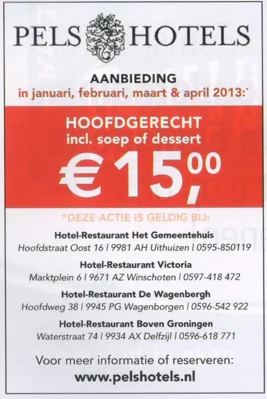
If you want to track the brutal reality of inflation over the last decade, you only need to look at the restaurant advertisements in old football programmes. On page 70, a bright red advertisement for Pels Hotels offers a deal that seems almost entirely fictional to a modern reader: a main course, including soup or dessert, for exactly €15.00.
But beyond the economic time capsule of the price tag, this advertisement is a beautiful geographical map of the northern hospitality sector. Pels Hotels was not a centralized city brand; it was a network of regional hotel-restaurants deeply embedded in the rural province (the Ommelanden). The ad lists four specific locations: Het Gemeentehuis in Uithuizen (the far north), Victoria in Winschoten (the east), De Wagenbergh in Wagenborgen, and Boven Groningen in the port city of Delfzijl. By advertising in the Euroborg, this regional network was inviting the city-dwelling fans to take a drive out into the province for a Sunday dinner, while simultaneously reminding the rural fans that their local hotel was a proud supporter of the region’s biggest club.
A Look into the Future
By 2026, the hospitality industry has been fundamentally reshaped by rising energy costs, labor shortages, and inflation. The idea of a sit-down, three-course meal at a hotel restaurant for €15 is mathematically impossible today. Furthermore, the rural hospitality sector in towns like Wagenborgen and Delfzijl has had to show incredible resilience to survive the economic shifts and the seismic crisis in the region. Yet, these local hotel-restaurants remain the vital social beating hearts of their respective villages, hosting weddings, local meetings, and post-match debates just as they did in 2013.