
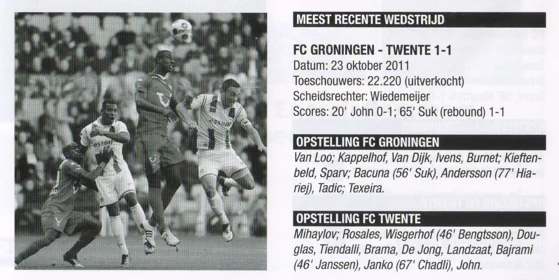
Sometimes, the most compelling stories in a matchday programme are hidden in the smallest font sizes. On page 9, the “MEEST RECENTE WEDSTRIJD” (Most Recent Match) box details a 1-1 draw between FC Groningen and FC Twente from October 23, 2011. If you look closely at the “OPSTELLING FC TWENTE” (Twente Lineup) printed at the very bottom, you are looking at a terrifying assembly of footballing firepower.
Just a year removed from their historic Eredivisie championship, the Twente squad listed here is absurdly talented. The attack features the towering Austrian Marc Janko, flanked by future Premier League and Belgian international star Nacer Chadli, and spearheaded by a young Luuk de Jong. The defense is anchored by the Brazilian-Dutch giant Douglas. This was a team built with Champions League money, designed to dominate Dutch football for a decade. Yet, in the cauldron of a sold-out Euroborg, this multi-million-euro golden generation was held to a 1-1 draw. And who scored the 65th-minute equalizer for Groningen? Hyun-Jun Suk, the passionate, hard-working South Korean cult hero, who smashed in a rebound to secure a point against the reigning heavyweights.
A Look into the Future
Looking at that Twente lineup from the perspective of 2026 evokes a profound sense of footballing whiplash. Players like Luuk de Jong went on to win European trophies with Sevilla and play for Barcelona, while Nacer Chadli became a staple in the English Premier League. However, the club they left behind, FC Twente, would soon plunge into a catastrophic financial crisis, nearly facing bankruptcy and suffering a shocking relegation to the Eerste Divisie before eventually clawing their way back in the 2020s. Meanwhile, Hyun-Jun Suk embarked on a wild, nomadic career across Europe and Asia. This tiny printed box is a perfect snapshot of an era when Twente ruled the land, and a South Korean striker made the Euroborg roar.