
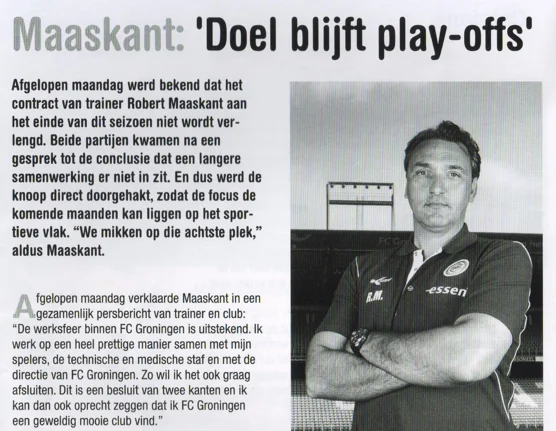
The “De Warming Up” column on page 2 of the March 2013 matchday programme is not a standard tactical preview; it is a formal, public resignation letter. Under the headline “Doel blijft play-offs” (Goal remains playoffs), manager Robert Maaskant addresses the FC Groningen fanbase directly regarding the breaking news that his contract would not be extended at the end of the season.
“Both parties came to the conclusion after a conversation that a longer collaboration is not in the cards,” Maaskant writes with professional detachment. “And so the knot was cut immediately, so that the focus for the coming months can lie on the sporting level.” This is the classic “lame duck” scenario in football management. Maaskant had to find a way to motivate a squad for the final eight matches of the season, knowing he would not be there to reap the long-term rewards. He emphasizes that the working atmosphere remains excellent and sets a hard target: erasing the six-point gap behind NEC and ADO Den Haag to secure the eighth spot and a European playoff ticket.
The immediate challenge was daunting. The team was coming off a frustrating draw against NAC Breda and was preparing to face a wounded FC Twente. Maaskant notes the tactical absences—Rasmus Lindgren for Groningen and Wout Brama for Twente, both suspended—and acknowledges that Twente, despite their recent struggles, remained a formidable former championship candidate.
A Look into the Future
By 2026, the concept of announcing a managerial departure mid-season remains a highly debated psychological gamble in football. Sometimes it causes a squad to down tools; sometimes it liberates them. For Robert Maaskant, the gamble paid off just enough. As we saw in the later programmes from this season, he successfully navigated this awkward period, riding the momentum of a Northern Derby victory to secure that coveted playoff spot before handing the reins over to Erwin van de Looi. This column captures the exact moment the transition of power began.