
Behind the glamour of professional football lies the complex, often difficult reality of youth development. On page 33, a seemingly mundane notice titled “GASTOUDERS GEVRAAGD” (Host Parents Wanted) reveals the hidden, human infrastructure required to run an elite football academy.
The FC Groningen youth academy (Jeugdopleiding) proudly states that 90% of its players come from the region. However, for the exceptional talents scouted from outside the immediate area—boys aged 16 to 19—the club needed a safe, stable home environment. The article appeals to local families in the city to open their doors, offering room and board to these young athletes. To prove the success of this system, the club lists notable alumni who successfully navigated the academy while living with host families, including Hilal Ben Moussa, Alim Öztürk, and local hero Danny Holla. Interested families were instructed to contact academy coordinator Mick Duzink.
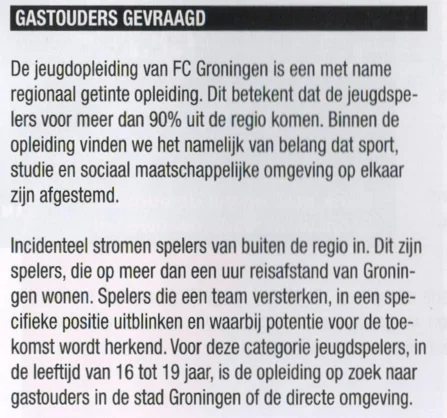
This small article highlights the immense personal sacrifices made by young players who leave their homes to chase a professional dream, and the crucial role that ordinary local citizens play in nurturing that talent. A host family doesn’t just provide a bed; they provide emotional stability during the most high-pressure years of a teenager’s life.
A Look into the Future
By 2026, the landscape of elite youth academies has become hyper-professionalized. Many top European clubs have built massive, hotel-like residential campuses for their youth players. However, clubs like FC Groningen still heavily rely on the host family (gastgezin) model. Sports psychologists increasingly advocate for this approach, arguing that living in a normal neighborhood with a surrogate family keeps young players grounded and socially integrated, preventing the institutionalized isolation of modern academy campuses. The unsung heroes requested in this 2013 article remain the emotional bedrock of the club’s future success.