
If you want to know what was keeping corporate IT managers awake at night in the early 2010s, you only need to read the B2B advertisements in a football programme. Page 28 features a prominent ad for QNH Consulting Noord B.V., an IT business integration firm. Under the football-themed slogan “Scoren door samenwerken!” (Scoring through collaboration), the ad text is a glorious time capsule of 2013 technology buzzwords.
The copy specifically highlights their expertise in “BYOD oplossingen” (Bring Your Own Device solutions) and the unlocking of information using “HTML5”. In 2013, the corporate world was undergoing a massive, often painful transition. Employees were suddenly bringing their personal iPhones and iPads into the office and demanding access to corporate networks, creating a security nightmare known as BYOD. Simultaneously, the web was transitioning away from clunky, dying plugins like Adobe Flash towards the new, mobile-friendly standard of HTML5.
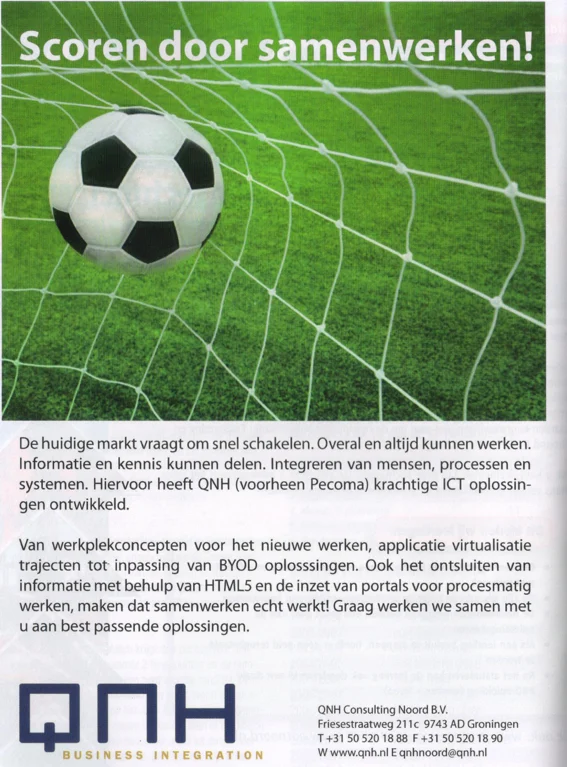
By advertising these specific solutions in the FC Groningen programme, QNH was directly targeting the directors and IT managers sitting in the sponsor lounges. It shows that the business clubs of the Euroborg were not just places to drink beer and talk about football; they were vital networking hubs where the digital transformation of the northern Dutch economy was being sold and negotiated.
A Look into the Future
By 2026, the buzzwords that defined this 2013 advertisement have become entirely obsolete because they were so successful. “BYOD” is no longer a cutting-edge corporate strategy; it is the absolute standard, heavily managed by invisible Mobile Device Management (MDM) software. Similarly, “HTML5” is no longer a selling point; it is simply the invisible fabric of the modern internet. QNH Consulting itself eventually merged and rebranded (becoming part of the larger Ilionx group), following the natural consolidation of the IT industry. Yet, this printed ad remains a perfect snapshot of the exact moment the northern business world had to rapidly adapt to the smartphone revolution.