
When we think of football sponsorships, we usually picture beer brands, sports apparel, or betting companies. But the grassroots reality of regional football commerce is often much more industrial. Dominating the bottom of the advertising page in the early 2013 programme is a bright yellow and grey ad for Jager & Zn. BV and Swieringa Kunststof, offering products that the average fan in the stands will never buy: wooden pallets, steel barrels, IBC tanks, and Big Bags.
This advertisement is a window into the heavy industrial and agricultural logistics of the northern Netherlands. The region, connected to the bustling ports of Eemshaven and Delfzijl, is a massive hub for chemical processing, agriculture, and shipping. These industries require an endless supply of industrial packaging. By advertising in the FC Groningen programme, Jager & Zn. BV wasn’t trying to sell a plastic barrel to a family of four; they were targeting the logistics managers and factory owners who spend their weekends in the sponsor boxes of the stadium.
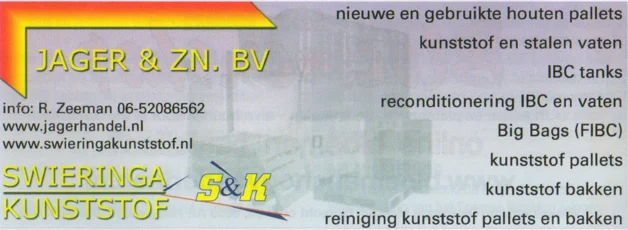
The ad also highlights “reconditioning IBC en vaten” (reconditioning IBCs and barrels) and cleaning services. In 2013, this was simply good, cost-effective business practice for industrial logistics.
A Look into the Future
By 2026, what was advertised merely as “reconditioning” in 2013 has been rebranded as the “Circular Economy”—one of the most critical and heavily subsidized sectors in the European Union. The industrial packaging recycling promoted by Swieringa Kunststof is now at the forefront of corporate sustainability goals. The heavy industry of the North has had to rapidly adapt to strict environmental regulations, making the cleaning and reusing of steel barrels and plastic tanks not just a cost-saving measure, but a mandatory ecological standard. This gritty, unglamorous ad was actually pointing towards the green industrial future of the region.