
Youth and reserve football is designed for development, but when a league title is on the line, the competitive agony is just as real as it is for the first team. Page 47 of the May 2014 matchday programme documents a spectacular, yet ultimately heartbreaking, finish to the season for Jong FC Groningen (the reserves).
Under the guidance of trainer Paul Raveneau, the reserves had been fighting a season-long battle at the top of the Beloftencompetitie A. The text reveals that they did absolutely everything in their power during the final weeks to snatch the title. They obliterated PEC Zwolle 0-6 away from home, and then won an insane, nine-goal thriller against northern rivals sc Heerenveen (5-4).
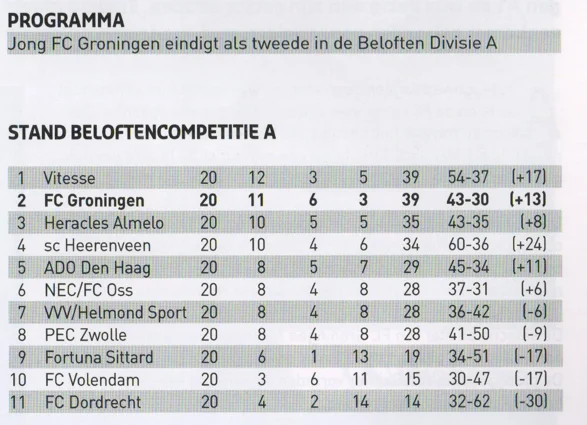
However, a glance at the final league table printed on the page shows the cruel mathematics of football. Both Jong FC Groningen and Vitesse finished the 20-game season with exactly 39 points. But Vitesse claimed the championship—and the ticket to the national playoff final against Feyenoord—because their goal difference was (+17) compared to Groningen’s (+13). Missing out on a league title by just four goals over an entire season is a bitter pill to swallow for young players trying to prove their worth to the first-team manager.
A Look into the Future
The heartbreak documented on this page was one of the last chapters of the isolated reserve league system in the Netherlands. Shortly after this era, the KNVB radically restructured the pyramid, forcing professional reserve teams to integrate into the senior leagues (like the Keuken Kampioen Divisie or Tweede Divisie) to face hardened adult professionals rather than their peers. For the players in Paul Raveneau‘s squad, this near-miss served as a harsh lesson in the fine margins of professional football—margins they would have to master if they wanted to survive in the Eredivisie.