
Football is a game often dominated by flashy wingers and hyped teenagers, but true value is measured in cold, hard efficiency. Page 21 of the May 2014 matchday programme provides a fascinating statistical reality check for the FC Groningen fanbase. Tucked in the top right corner is a table titled “GEMIDDELDE IN EREDIVISIEDUELS” (Average in Eredivisie matches), ranking the current squad by their goals-per-game ratio.
While the media spotlight that season was firmly fixed on the explosive Serbian winger Filip Kostić and the 17-year-old prodigy Richairo Živković, the table reveals a different king of efficiency. Sitting at number one is Michael de Leeuw, boasting an impressive 0.358 goals per game (19 goals in 53 matches). He comfortably beats out Živković (0.281) and Kostić (0.237), with Tjaronn Chery and Género Zeefuik rounding out the top five.
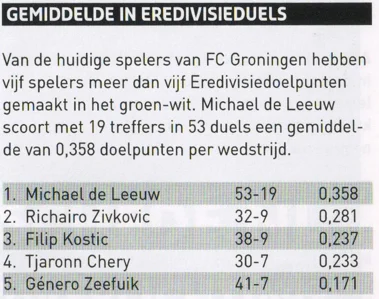
This table is a testament to De Leeuw’s incredible footballing intelligence. He wasn’t the fastest player, nor the most technically gifted dribbler, but his positioning inside the penalty area was elite. He was the ultimate poacher, a player who needed very few touches to find the back of the net. For the tactical purists in the stands, this small statistical block was the ultimate proof of his indispensable value to the team.
A Look into the Future
Michael de Leeuw‘s ruthless efficiency only grew in the years following this publication. He would eventually become the all-time top goalscorer for FC Groningen in the Euroborg stadium, a record that cements his status as a modern club legend. While players like Kostić and Živković moved on to high-profile transfers abroad, De Leeuw remained the reliable, goal-scoring heartbeat of the club, proving that consistency and positioning will always outscore pure hype.