In modern, hyper-commercialized football, advertising space in a matchday programme is usually reserved for corporate sponsors pushing their latest products. But on page 26 of the March 2014 edition, the commercial logic of the Euroborg was hijacked by pure, unadulterated provincial pride. The entire page is dedicated to a single, triumphant photograph of a young Hans Hateboer, accompanied by a heartwarming headline: “De volgende bedrijven uit Beerta zijn trots op HANS HATEBOER!” (The following companies from Beerta are proud of HANS HATEBOER!).
Beerta is a small village in the Oldambt municipality of the Groningen province, with a population of just over 2,000 people. When Hateboer—a local boy who started his journey at the village amateur club—suddenly broke into the FC Groningen first team, provided a crucial assist, won Man of the Match, and signed his first professional contract all within a few weeks, the village erupted in pride. Local business owners pooled their resources to buy a full-page ad in the official club magazine simply to congratulate him.
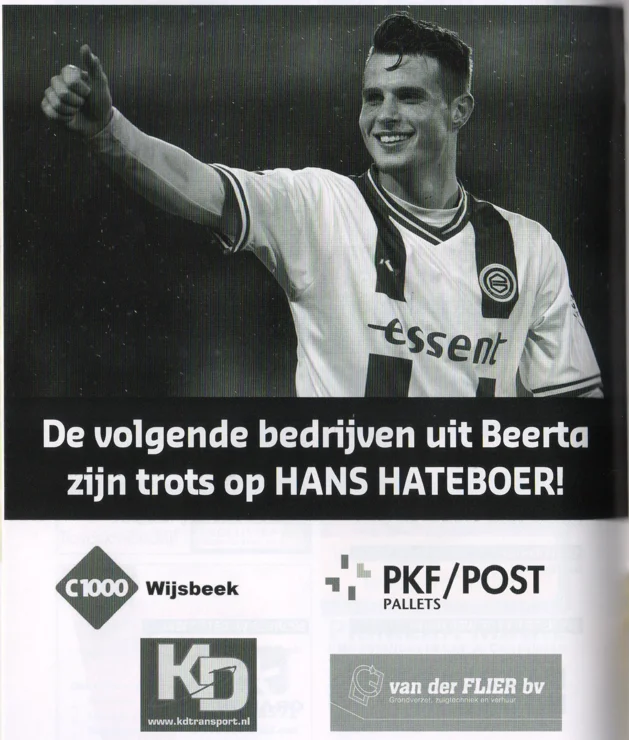
The four logos at the bottom of the page form a beautiful, rugged cross-section of the local northern economy. We see C1000 Wijsbeek—a local franchise of the iconic orange supermarket chain that would completely disappear from the Netherlands just a year later. We see van der Flier bv, the exact same 250-year-old earthmoving company whose anniversary we documented in an earlier matchday programme. But the industrial backbone of the tribute is provided by the other two sponsors. KD Transport, a logistics company founded in 1951, represents the trucks that have kept the region moving for generations. Next to them is PKF/POST Pallets, a major wood processing and pallet manufacturing firm.
These aren’t faceless multinational corporations; these are the heavy-lifting, blue-collar employers of the region. They are the people who build the roads, move the freight, process the timber, and sell the groceries. They watched Hateboer grow up, and now they were paying premium rates to tell the 20,000 fans in the stadium that the boy on the pitch belonged to them.
A Look into the Future
The investment made by those four companies in Beerta yielded an incredible emotional return. Hans Hateboer didn’t just become a solid Eredivisie player; he became one of the most successful exports in the history of the northern Netherlands. His relentless work ethic eventually earned him a transfer to Italy, where he became a legendary figure for Atalanta BC. He played in the UEFA Champions League, won the Europa League, and wore the orange shirt of the Dutch national team. But no matter how famous he became on the streets of Bergamo, or how many elite European stadiums he conquered, this 2014 printed page proves that his foundation was built on the wooden pallets, transport trucks, and unwavering support of his home village.