Throughout the 2013/2014 season, the matchday programmes of FC Groningen read like a disciplinary rap sheet. We previously documented their insane 75-match streak of receiving cards and their red card epidemic. On page 21 of the February 16 edition, the club’s editors decided to lean fully into this “bad boy” reputation by publishing a 20-season historical overview of their yellow card accumulation.
Under the simple header “GELE KAARTEN” (Yellow Cards), the table tracks the club’s bookings from the 1994/1995 season all the way to the current 2013/2014 campaign. It is a fascinating statistical map of northern aggression. You can see the absolute peaks of physical play: the 1996/1997 season with a staggering 74 yellow cards, and the recent 2012/2013 season which nearly matched it with 72.
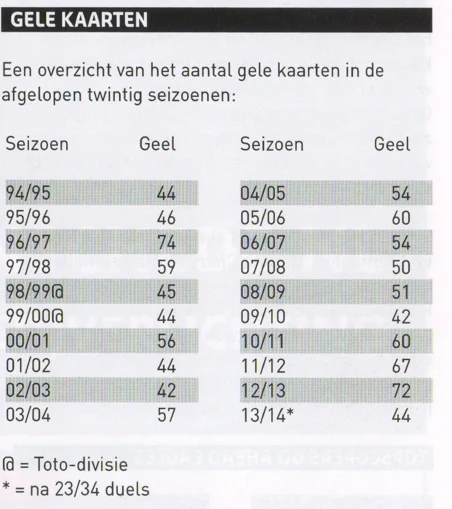
At the time of printing, the team already had 44 yellow cards with 11 matches still left to play. Publishing this table wasn’t an apology; it was an acknowledgment of the club’s cultural DNA. The fans at the Euroborg demand attractive football, but above all, they demand that their players fight for every inch of grass. Sometimes, that fight results in a booking. The table proves that this wasn’t a recent crisis; it was a two-decade-long tradition of uncompromising physical football.
A Look into the Future
While the sheer volume of cards fluctuated in the years following 2014, the core identity of FC Groningen as a tough, resilient opponent never wavered. Manager Erwin van de Looi eventually managed to harness this aggression, turning reckless tackles into organized, suffocating pressing, which directly led to the club’s KNVB Cup victory in 2015. Today, this 20-year ledger of yellow cards stands as a hilarious, printed monument to the era when playing against Groningen meant you were guaranteed to leave the pitch with a few bruises.