Sometimes, the layout of a matchday programme tells a better story than the text itself. Page 21 of the November 2013 edition against Roda JC is a masterpiece of editorial irony, setting the stage for what promised to be an absolutely chaotic 90 minutes of football at the Euroborg.
On the right side of the page sits a block titled “FAIR PLAY: 18 VS. 17”. It details the current standings of the KNVB Fair Play Cup. Out of 18 Eredivisie teams, Roda JC sat in 17th place, and FC Groningen was dead last in 18th. The text bluntly explains why: Roda had already seen four players sent off, while Groningen had collected a massive 25 yellow cards and their own collection of reds. It was, statistically speaking, the dirtiest fixture possible in Dutch football. Just below this, a small note warns that Groningen captain Rasmus Lindgren is “Op Scherp” (on edge), sitting on four yellow cards and one foul away from suspension.
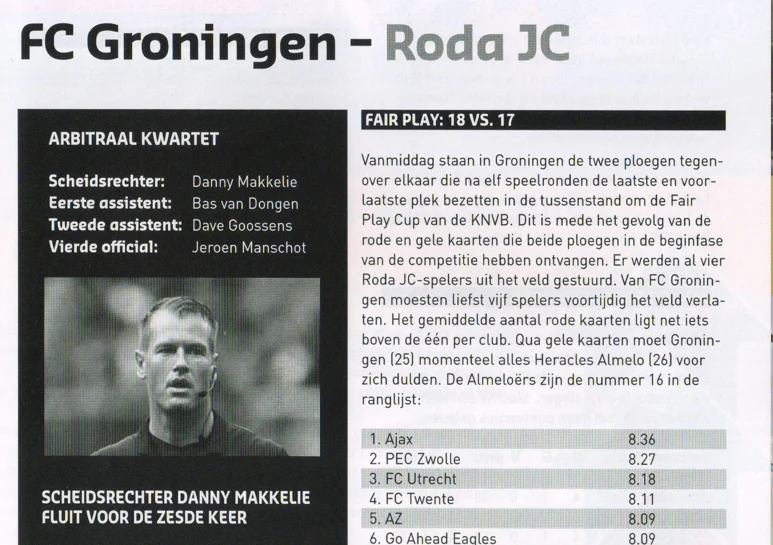
But the punchline is the man appointed to keep order in this impending brawl: referee Danny Makkelie. The editorial block next to his photo notes that this is his sixth time refereeing Groningen. The staggering statistic? In his previous five matches involving the club, an average of 5.2 goals were scored per game (including wild scorelines like 3-2, 4-2, and 3-1). The KNVB had essentially assigned a referee who guarantees goal-scoring chaos to oversee a match between the two most aggressive, card-prone teams in the country.
A Look into the Future
The young referee pictured on this page, Danny Makkelie, would go on to become one of the most elite and recognizable referees in world football. By 2026, he has officiated UEFA Champions League semi-finals, European Championship matches, and World Cup fixtures. His authority on the pitch is now unquestioned globally. But looking back at this 2013 programme, it is highly amusing to see him framed not as an elite UEFA official, but as the unwitting ringmaster assigned to manage the Eredivisie’s ultimate “dirty derby” at the Euroborg.